
Flat Roof Maintenance UK: Common Problems and How to Prevent Them
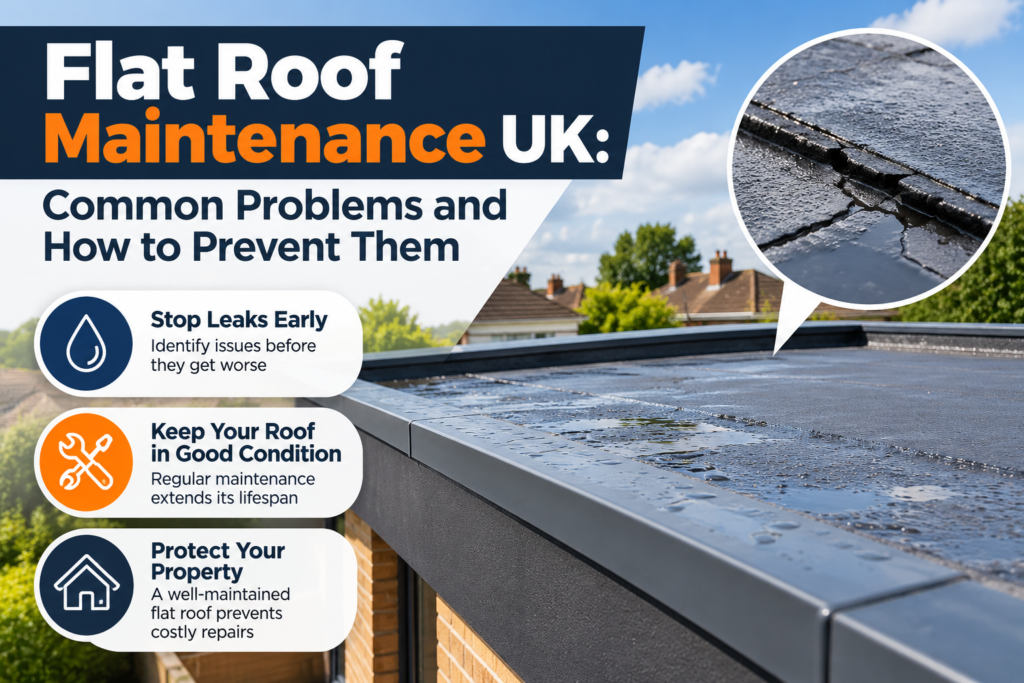
Flat roofs fail most often through ponding water, membrane splits, and perished edge details, all of which are made worse by blocked drainage and lack of regular inspection. Checking for standing water, cracking, and blistering twice a year, and clearing debris from outlets, prevents most flat roof problems from becoming serious leaks.
Flat roofs work differently to pitched roofs, and they demand a different kind of attention. Instead of relying on steep slopes to shed water quickly, a flat roof depends on a slight fall and a continuous, intact membrane to keep water out, which means even a small defect can allow water to sit and work its way in over time rather than running straight off.
This guide covers the most common flat roof problems in UK homes, how to spot them early, and the maintenance routine that keeps a flat roof performing for its full expected lifespan.
How a Flat Roof Is Actually Built
Despite the name, a flat roof is rarely completely level. It is built with a slight fall, typically toward one or more drainage outlets, so that rainwater moves off the surface rather than collecting on it. Beneath the visible surface, layers typically include a structural deck, insulation, and a waterproof membrane, which might be built-up felt, a single-ply membrane, or a liquid applied coating, depending on the age and specification of the roof.
Understanding this layered structure matters because a problem with the membrane on the surface can eventually affect the insulation and deck beneath it if water finds a way through, which is why even minor surface defects are worth addressing promptly rather than waiting until a leak appears inside the property.
Common Flat Roof Problems in the UK
Ponding Water
Standing water that remains on the roof surface for more than a day or two after rain has stopped is one of the most common flat roof issues, usually caused by an insufficient fall, a sagging deck, or blocked drainage preventing water from reaching the outlet. Prolonged ponding accelerates wear on the membrane and adds significant weight to the roof structure during heavy rainfall.
Membrane Splits and Cracking
Felt and single-ply membranes can crack or split over time, particularly at points of movement such as where the roof meets a wall or parapet, due to thermal expansion and contraction through seasonal temperature changes. Once a split forms, it provides a direct route for water into the layers beneath.
Blistering
Small bubbles or raised areas on the membrane surface, known as blistering, often indicate trapped moisture or air beneath the surface layer, which can eventually rupture and expose the roof to water ingress if left untreated.
Perished Edge and Upstand Details
The edges of a flat roof, along with upstands where the roof meets a wall or parapet, are common failure points because they involve joints and transitions rather than a continuous flat surface. Cracked sealant or lifted edge trims at these details are frequently the first sign of a developing problem.
Blocked or Damaged Outlets
Leaves, moss, and general debris can block the outlets that allow water to drain from the roof, directly causing or worsening ponding issues elsewhere on the surface.
UV Degradation
Continuous exposure to sunlight gradually breaks down many roofing membranes over time, making the surface more brittle and prone to cracking, particularly on older felt roofs that were not finished with a reflective or protective top layer. High winds during a storm can also lift an already brittle edge, a scenario covered in our storm roof damage checklist.
How to Inspect a Flat Roof Safely
Flat roofs are generally safer to walk on than pitched roofs, but this does not mean access should be taken lightly. If your flat roof is accessible via a fixed ladder or from an adjoining window, a careful visual check twice a year, in spring and autumn, can catch developing problems early. Look specifically for standing water, visible cracking or splitting in the membrane, blistering, and any debris blocking drainage outlets.
For roofs that are difficult or unsafe to access directly, a drone roof survey provides an effective alternative, capturing detailed images of the entire surface, including ponding patterns and membrane condition, without anyone needing to walk on the roof at all. Our guide to drone roof surveys explains this process in more detail.
Why Flat Roofs Need More Frequent Attention Than Pitched Roofs
Because a flat roof relies entirely on its membrane and drainage to stay watertight, rather than gravity doing most of the work as on a pitched roof, small defects tend to become serious problems more quickly. A cracked tile on a pitched roof might shed most rainfall around it. A split in a flat roof membrane sits directly in the path of any water that collects nearby, giving it far more opportunity to find its way through.
This is why flat roofs generally benefit from more frequent inspection than pitched roofs, and why catching a small blister or hairline crack early, before it develops into a full split, makes such a significant difference to long term performance and cost.
Extending the Life of a Flat Roof
Keeping outlets and gutters clear of debris is one of the simplest and most effective maintenance tasks, directly reducing the risk of ponding. Trimming back overhanging branches reduces both debris buildup and the risk of physical damage from falling limbs during storms.
Addressing small defects promptly, rather than waiting for a full membrane failure, is significantly more cost effective over the life of the roof. A small crack resealed early is a minor repair. The same crack left to let water into the insulation and deck over successive winters becomes a much larger structural repair.
Where a flat roof has reached the end of its useful life, modern replacement options, including single-ply membranes and liquid applied systems, generally offer improved durability and lifespan compared with older felt systems, worth discussing as part of a full roof inspection.
Flat Roofs and Ventilation
Flat roof constructions can be built as either warm or cold roofs, similar in principle to the loft ventilation strategies covered in our dedicated ventilation guide. A cold flat roof has ventilation between the insulation and the deck, while a warm flat roof places insulation above the deck, avoiding the need for a ventilated void. Getting this detail wrong during a repair or replacement, such as adding insulation to a cold roof without maintaining adequate ventilation, can lead to condensation problems within the roof structure itself.
Flat Roof Materials Compared
Traditional Built-Up Felt
Built-up felt roofing, consisting of multiple bonded layers, has been used on UK flat roofs for decades and remains common on older properties. It is generally the least expensive option but also the most prone to UV degradation and cracking over time, particularly once it passes its expected lifespan without a protective top coat.
Single-Ply Membranes
Single-ply systems use a single, factory manufactured waterproof sheet, welded at the joints rather than relying on multiple bonded layers. These membranes generally offer better flexibility and UV resistance than traditional felt, translating into a longer expected service life with less frequent maintenance needed.
Liquid Applied Systems
Liquid applied roofing is painted or sprayed on as a liquid that cures into a seamless, fully bonded waterproof layer. This approach is particularly effective on roofs with complex shapes, upstands, and penetrations, since it flows into every detail without the joints and seams that other systems require.
Choosing between these options when replacing a flat roof depends on the specific roof shape, budget considerations, and how long you intend to remain in the property, since each material offers a different balance of upfront cost and long term durability.
Moss and Algae Growth on Flat Roofs
Flat roofs, particularly those in shaded areas beneath overhanging trees, are prone to moss and algae growth over time. While a light covering is often more of a cosmetic issue than a structural one, heavier growth can retain moisture against the membrane surface for extended periods, accelerating wear in exactly the areas already most vulnerable to ponding and UV damage.
Removing moss growth carefully, without scraping aggressively enough to damage the membrane surface underneath, and improving airflow around the roof by trimming nearby vegetation, both help reduce the rate at which growth returns after cleaning.
Flat Roofs on Extensions and Garages
Flat roofs are especially common on single storey extensions, garages, and porches, often built at a lower level than the main house roof, which means they can be more exposed to debris falling from taller sections of the property above, including moss, leaves, and even displaced pitched roof tiles during a storm. Regular clearance of this debris is particularly important for these lower level flat roof sections, since blocked outlets here can also contribute to water pooling against the main house wall if drainage is not kept clear.
Extension and garage flat roofs also tend to be more accessible than roofs on the main house, making them a practical starting point for homeowners wanting to carry out their own basic visual checks between professional inspections.
Flat Roof Insulation Upgrades
Older flat roofs are often under-insulated by current standards, and a full membrane replacement presents a natural opportunity to improve insulation at the same time, since the roof build-up is already being disturbed. Adding insulation above the deck, as part of a warm roof design, is generally the preferred approach for flat roofs undergoing renewal, since it avoids the ventilation complexity associated with a cold roof design while also protecting the structural deck from temperature extremes.
This is worth discussing whenever a flat roof replacement is being planned, since the cost difference between simply replacing the membrane and upgrading insulation at the same time is often modest compared with the ongoing energy savings and improved comfort in the room below.
Choosing a Contractor for Flat Roof Work
Flat roofing is a distinct specialism from pitched roof work, requiring familiarity with membrane welding, fall calculation, and detailing around upstands and outlets that differs meaningfully from tiling or slating skills. When sourcing quotes, it is worth confirming specific flat roofing experience rather than assuming general roofing competence automatically covers it, echoing the same principle covered in our guide to choosing a roofing contractor.
Flat Roof Maintenance Across London, Surrey and the South East
Flat roofs are especially common on London extensions, garages, and older properties with rear additions, where access for inspection is often more constrained by neighbouring buildings. Across Surrey and the South East, flat roofed garden rooms and outbuildings face additional exposure to overhanging trees and debris. Nationwide Roof Professionals inspects and maintains flat roofs throughout these areas, using drone surveys where direct access is limited.
Frequently Asked Questions
How often should a flat roof be inspected?
Twice a year is a reasonable general guideline, in spring and autumn, along with a check after any particularly severe storm.
How long does a flat roof typically last?
Lifespan varies considerably by material and installation quality, with older felt roofs generally lasting less than modern single-ply or liquid applied systems, though all types benefit significantly from regular maintenance.
Is standing water on a flat roof always a problem?
Brief ponding after heavy rain that clears within a day or so is not usually a serious concern. Water that remains for several days or longer indicates a drainage or fall issue that should be investigated.
Can a flat roof be repaired without full replacement?
Yes, in many cases. Localised splits, blisters, and edge detail failures can often be repaired directly without needing to replace the entire membrane, provided the underlying deck and insulation have not been significantly affected.
Do flat roofs need different insurance considerations to pitched roofs?
Flat roofs are not inherently harder to insure, but insurers may ask about age, material, and maintenance history, since these factors affect the likelihood of a future claim.
Keeping a Flat Roof Watertight for the Long Term
Flat roofs reward regular attention far more than pitched roofs do, precisely because small defects have less margin for error before they become active leaks. A simple twice yearly check, combined with prompt repair of anything found, keeps a flat roof performing reliably for years.
Nationwide Roof Professionals provides full flat roof inspection, repair, and replacement as part of our roofing services. Get in touch for a free assessment and we will let you know exactly what condition your flat roof is in.