How to Choose a Roofing Contractor in the UK: What Actually Matters
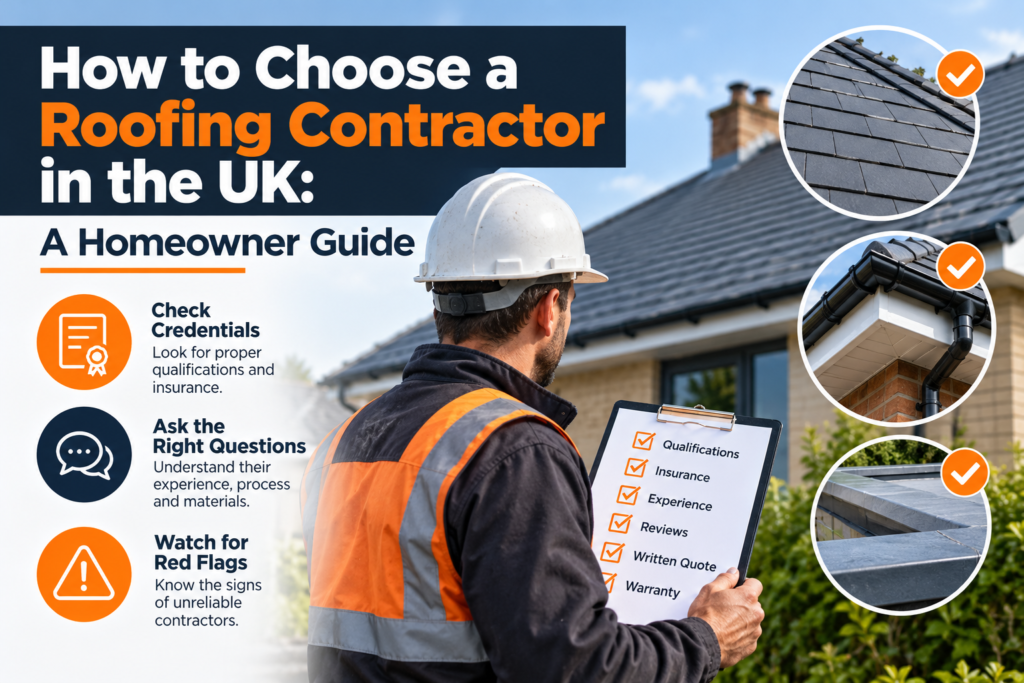
Choose a roofing contractor with verifiable trade body membership, current public liability insurance, a written itemised quote, and a clear guarantee. Avoid unsolicited doorstep offers, pressure for an immediate decision, and requests for large upfront payment. Ask to see examples of completed local work before committing.
Roofing sits in an unusual position among home improvement trades. The work happens above eye level, most homeowners cannot easily check the quality of what has been done, and by the time a problem shows up, whoever did the original work may be long gone. That combination makes choosing the right contractor one of the most consequential decisions in the entire process, arguably more important than the specific materials used.
This guide covers the credentials worth checking, the questions worth asking, and the red flags that should make you walk away before any work begins.
Why Choosing the Right Contractor Matters More Than Choosing the Cheapest
Roofing problems caused by poor workmanship rarely show up immediately. A poorly fitted flashing detail, an under specified ventilation gap, or tiles laid with the wrong overlap can all look perfectly fine on the day the job finishes, and still fail within a few years, sometimes in ways that cause internal damage before anyone realises the original work was substandard.
Because so much of roofing quality is hidden once the job is complete, the reputation, accountability, and technical competence of the contractor matter more here than in trades where the finished result is fully visible and easy to assess.
Credentials Worth Checking
Trade Body Membership
Membership of a recognised trade body, such as the National Federation of Roofing Contractors or a similar accredited organisation, indicates that a contractor has met certain standards and agreed to a code of conduct. It also usually provides homeowners with an avenue for dispute resolution if something goes wrong, which is not available when working with an unaffiliated contractor.
Public Liability Insurance
Any contractor working at height on your property should hold current public liability insurance, protecting you if their work causes damage to your property or if a third party is injured during the job. Ask to see a current certificate rather than simply taking a verbal assurance, since this is straightforward for a legitimate contractor to provide.
Manufacturer Accreditation
For specific products, such as certain insulation systems or roofing membranes, manufacturers often accredit installers who have completed specific training on that product. Where a manufacturer backed guarantee is being offered, confirming the installer holds the relevant accreditation ensures that guarantee is actually valid.
Health and Safety Compliance
Roofing work carries genuine risk, and a contractor with proper health and safety practices, including appropriate access equipment and fall protection, is generally also more careful and organised in their actual workmanship. Visible corner cutting on safety during a site visit is often a sign of corner cutting elsewhere too.
Questions Worth Asking Before Committing
Can I See Examples of Similar Completed Work?
A contractor confident in their work should be able to show photographs of previous, similar projects, and ideally provide contact details or reviews from those customers. Reluctance to provide any evidence of past work is worth noting.
What Guarantee Comes With the Work?
Ask specifically what is covered, for how long, and whether the guarantee is backed by the contractor directly or by an independent insurance backed warranty, which continues to protect you even if the contractor later stops trading.
How Will You Handle Access and Scaffolding?
Understanding whether scaffolding is included in the quote, who is responsible for it, and how long it will remain up avoids confusion and unexpected costs partway through the project.
What Happens If You Find Additional Issues Once Work Starts?
Roofing work sometimes reveals problems that were not visible during the initial quote, such as rotten timber beneath old tiles. A contractor who explains clearly how additional issues would be identified, communicated, and priced is being transparent about a genuinely common scenario, rather than leaving it as a surprise.
Who Will Actually Be Doing the Work?
Some companies subcontract roofing work to third parties. There is nothing inherently wrong with this if the subcontractors are properly vetted and insured, but it is worth knowing in advance who will physically be on your roof and under whose direct supervision.
Red Flags to Watch For
Unsolicited Doorstep Offers
A contractor who knocks on your door claiming to have noticed a problem with your roof from the street, often offering an immediate, heavily discounted price, is a well known pattern associated with poor quality or fraudulent work. Legitimate contractors rarely need to generate business this way.
Pressure to Decide Immediately
Genuine, busy contractors are rarely desperate enough to require an on the spot decision. Pressure tactics, especially combined with claims that a discount is only available today, are a significant warning sign.
Requests for Large Upfront Payment
While a reasonable deposit is standard practice for materials, requests for full or near full payment before any work has started leave you with little recourse if the contractor fails to complete the job to standard, or at all.
No Fixed Address or Verifiable Business Details
A contractor without a registered business address, verifiable company details, or an established online presence is much harder to hold accountable if problems arise later. A quick company registration check takes only a few minutes and provides useful reassurance.
Vague or Verbal Only Quotes
A written, itemised quote allows you to compare contractors fairly and provides a clear record of what was agreed if a dispute arises later. Reluctance to put a quote in writing, or a quote that lacks any specific detail about materials and scope, makes it difficult to know exactly what you are paying for.
Reviews That Seem Too Uniform or Too Recent
A pattern of reviews all posted within a short period, using similar language, can sometimes indicate reviews were solicited in bulk rather than reflecting genuine, organic customer feedback over time. This is not proof of a problem on its own, but it is worth factoring in alongside other checks.
Understanding What a Fair Quote Actually Includes
A thorough, professional quote should specify the materials to be used, including brand and specification where relevant, the scope of work in clear terms, who is responsible for waste removal and site clearance, the expected timeframe for the work, and the terms of any guarantee offered.
Quotes that are significantly lower than others received for the same scope of work are worth examining closely, since a lower price often reflects lower specification materials, less experienced labour, or corners being cut somewhere in the process that will only become apparent later. This does not mean the most expensive quote is automatically the best, but an unusually low quote deserves the same scrutiny as an unusually high one.
How Local Reputation and Completed Projects Help
Beyond formal credentials, a contractor’s track record of completed local projects gives a practical sense of their actual, real world workmanship rather than relying purely on marketing claims. Asking to see, or being shown, a portfolio of finished roofs, ideally including projects similar in scope to your own, gives a more grounded basis for comparison than reviews alone.
At Nationwide Roof Professionals, our completed projects page shows examples of roofing, insulation, and spray foam removal work carried out across the UK, giving prospective customers a clear view of the standard of finish before any commitment is made.
The Role of Technology in Modern Roofing Assessments
Contractors who use tools such as drone roof surveys to assess a roof before quoting are typically demonstrating a more thorough, evidence based approach to scoping work, compared with a brief visual assessment from ground level. Our own guide to drone roof surveys explains how this technology gives a clearer, more accurate basis for both the quote and the eventual repair plan.
Similarly, a contractor willing to explain technical decisions, such as why a particular ventilation approach is needed alongside insulation work, is generally demonstrating genuine expertise rather than simply completing a standard package regardless of your property’s specific needs.
What Happens After the Work Is Complete
A reputable contractor should be willing to walk through the completed work with you, explaining what was done and why, and should provide any relevant documentation, including guarantees, certificates for specific products used, and, where applicable, building control sign off for notifiable work.
Keeping this documentation safe matters beyond simple reassurance. It can be required for future insurance claims, mortgage applications, or if you sell the property and need to demonstrate that roofing work was carried out to a proper standard by a competent contractor.
Comparing Contractors Fairly When Quotes Look Different
It is common to receive quotes for the same job that differ noticeably in structure, not just price. One contractor might itemise every material and labour cost separately, while another provides a single lump sum figure. Before comparing purely on the bottom line, it helps to convert quotes into a comparable format by checking that each one covers the same scope, including waste removal, scaffolding, and any making good of internal decoration disturbed during the work.
It is also worth asking each contractor to clarify what is explicitly excluded from their quote. Exclusions such as unforeseen timber replacement, additional scaffolding for difficult access, or disposal of hazardous materials can significantly affect the final cost if they are not clarified upfront, regardless of how competitive the initial figure appears.
Specialist Work Deserves Specialist Experience
General roofing competence does not automatically transfer to every specialist task a property might need. Spray foam removal, for example, requires specific knowledge of how different foam types bond to timber and how to extract them without causing further structural damage, a very different skill set from standard tiling or flashing work.
When a project involves a specific, less common requirement, such as spray foam removal, cavity wall insulation, or drone survey based assessment, it is reasonable to ask directly about the contractor’s specific experience with that exact type of work, rather than assuming general roofing experience automatically covers it.
The Value of a Company That Handles the Full Roof System
Roofs, insulation, and ventilation interact closely, as covered throughout our other guides on this topic. A contractor who only handles the tiles and coverings, without considering ventilation, insulation interaction, or the condition of fascias and soffits, may resolve one visible problem while leaving an underlying issue untouched.
Working with a company that understands and offers the full range of related services, roofing, insulation, and specialist removal work, tends to result in more joined up recommendations, since the same team is considering how each element affects the others rather than treating the roof as a set of disconnected components.
Trusting Your Own Judgement Alongside the Checks
Credentials and written processes matter, but so does the general impression a contractor gives during initial contact. A team that answers questions clearly, arrives on time for a survey, and communicates in a straightforward, unhurried way is often reflecting the same standards they will bring to the actual work on your roof. Conversely, a contractor who is difficult to reach before any money has changed hands is unlikely to become easier to reach once a deposit has been paid and work is underway.
Frequently Asked Questions
Do I need multiple quotes before choosing a roofing contractor?
Getting at least two or three quotes for anything beyond a very minor repair is generally worthwhile, since it gives a realistic sense of fair pricing and highlights any outlier, whether unusually high or unusually low, that deserves closer examination.
Is it normal to pay a deposit before roofing work starts?
Yes, a reasonable deposit to cover material costs is standard practice. What matters is that the deposit is proportionate to the overall job value and that the remaining balance is tied to satisfactory completion of the work.
How do I check if a roofing company is properly insured?
Ask directly for a copy of their current public liability insurance certificate. A legitimate contractor will have no hesitation providing this, and it is worth checking the policy dates are current rather than expired.
What should I do if I am not happy with completed roofing work?
Raise concerns directly with the contractor first, ideally in writing, giving them the opportunity to inspect and address the issue. If this does not resolve the problem, trade body membership or an insurance backed guarantee provides a formal route for dispute resolution.
Does a cheaper quote always mean lower quality?
Not always, but a significantly lower quote compared with others for the same scope of work usually reflects a difference somewhere, whether in materials, labour experience, or guarantee terms. It is worth understanding exactly what accounts for the difference before deciding based on price alone.
Choosing a Contractor in London, Surrey and the South East
Local knowledge matters more than it might seem. A contractor familiar with common roof types and planning restrictions in your specific area, including conservation area rules that apply in parts of London and Surrey, can flag potential permission issues before work starts rather than after, a topic covered fully in our planning permission for roof work guide. Nationwide Roof Professionals is based in Surrey and works across London and the South East, giving us direct familiarity with the property types and regulations homeowners in these areas typically encounter.
Making a Confident Decision
Choosing a roofing contractor is ultimately about trust in work you cannot easily verify yourself once it is finished. Checking credentials, asking direct questions, and being alert to common red flags puts you in a far stronger position to make that decision with confidence.
Nationwide Roof Professionals is fully insured, experienced across roofing, insulation, and spray foam removal, and happy to answer any of the questions raised in this guide directly. Get a free, no obligation quote and see for yourself how we approach a project before you commit to anything.