
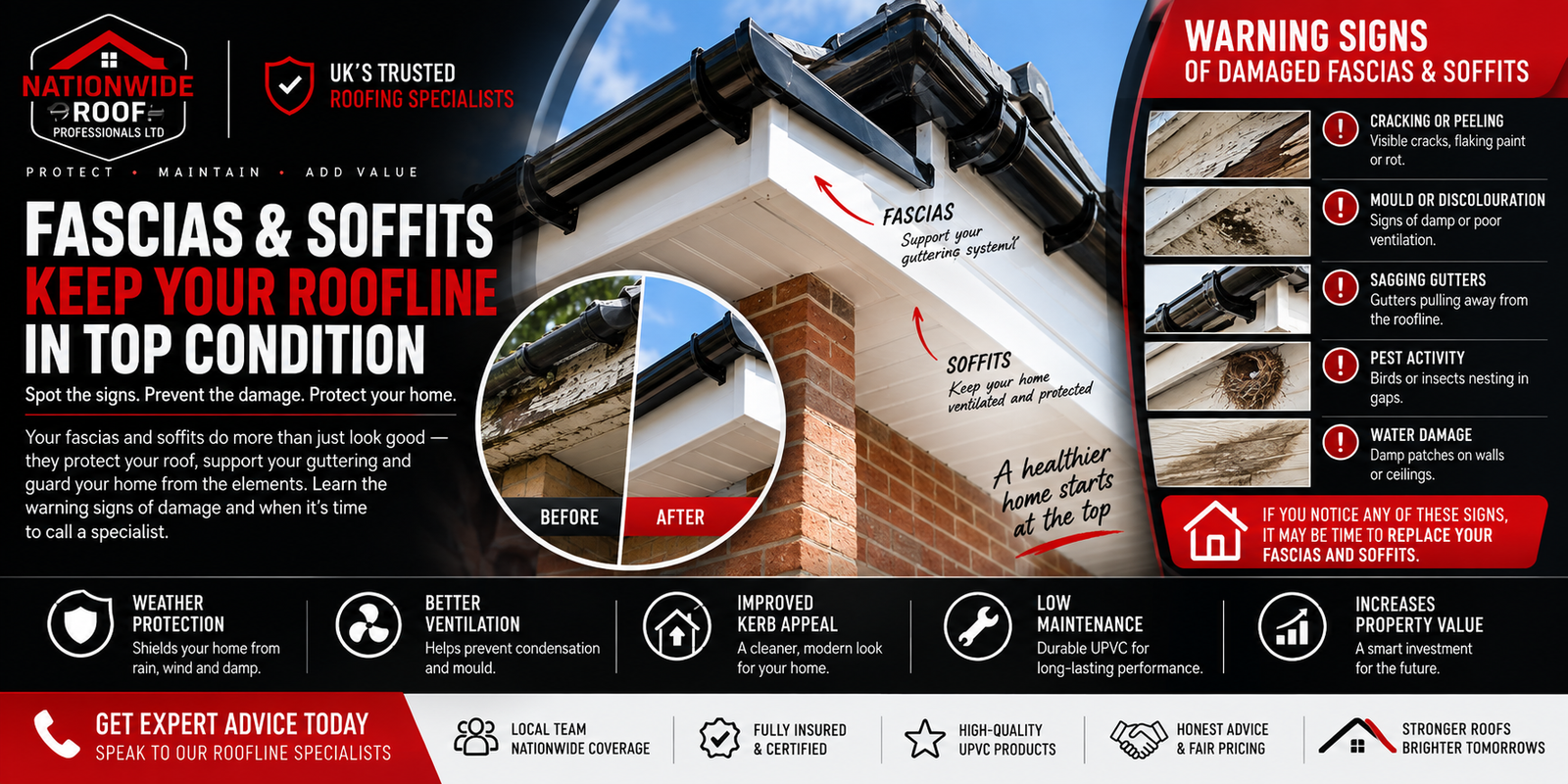
Quick answer: Fascias and soffits are the boards along your roof edge that support guttering, seal the roof void, and allow the loft to ventilate. Warning signs of failure include sagging gutters, peeling paint or rot on timber boards, water staining on walls, and pest activity in the loft. Left unrepaired, damage spreads into the roof structure itself.
A cracked soffit board rarely looks urgent. It sits high above eye level, tucked under the roofline, and most homeowners never think about it until water starts coming through the ceiling below. Fascias and soffits protect the timber structure of your roof, and once they fail, the damage spreads fast.
This guide explains what fascias and soffits actually do, the signs that yours are failing, and why replacing them early protects far more than the appearance of your home.
What Are Fascias and Soffits?
The fascia is the straight board that runs along the edge of your roof, fixed to the ends of the rafters. It holds your guttering in place and forms the visible trim between the roof and the outside wall. The soffit is the board underneath, closing the gap between the fascia and the wall of the house.
Together, they do three jobs most homeowners never consider:
- They seal the roof void from wind, rain, birds, and pests
- They support the guttering system, which controls where rainwater goes
- They allow the roof space to breathe through ventilation gaps, which reduces condensation risk
When either component fails, all three functions are compromised at once, which is why problems here tend to escalate quickly compared with issues on other parts of the property.
Materials Used for Fascias and Soffits in the UK
Older UK properties, particularly those built before the 1990s, often have timber fascias and soffits. Timber looks attractive when well maintained but requires regular painting or staining, and it is vulnerable to rot once the protective coating breaks down.
Most homes renovated in the last two decades use uPVC fascias and soffits instead. uPVC does not rot, does not need repainting, and resists moisture far better than timber. It has become the standard replacement material because it lasts significantly longer with minimal upkeep, which matters for a part of the building that is difficult and costly to access repeatedly.
Composite and aluminium options also exist for period or listed properties where uPVC is not permitted, though these are less common on standard residential roofs.
Signs Your Fascias and Soffits Need Attention
1. Peeling Paint or Visible Rot on Timber Boards
If you have timber fascias, peeling paint is often the first visible clue that moisture is getting underneath the surface. Left unchecked, this leads to soft, spongy timber that can no longer hold fixings securely.
2. Sagging or Detached Guttering
Guttering is fixed directly to the fascia board. If the fascia has softened or rotted, the fixings lose their grip and the guttering starts to sag, pull away from the wall, or drop at the joints. This is one of the clearest external signs that the board behind it needs inspection.
3. Water Staining on External Walls
Streaks of discolouration running down brickwork below the roofline usually mean water is overshooting the guttering system rather than draining through it properly. This often traces back to a damaged fascia allowing gutters to sit at the wrong angle.
4. Signs of Pest Activity in the Loft
Gaps that develop where soffits have cracked or come loose give birds, wasps, and rodents an easy route into the loft space. If you are hearing scratching in the roof void or finding nesting material, damaged soffits are a common entry point worth checking.
5. Damp Patches on Ceilings Near External Walls
Because fascias and soffits sit at the junction between roof and wall, water ingress here often shows up as damp patches on upstairs ceilings close to the outer walls, rather than in the centre of a room.
6. Visible Cracking or Warping
uPVC can crack under UV exposure and extreme temperature changes over many years, particularly on south facing elevations. Warping or bowing along the length of the board is a sign the material has reached the end of its useful life.
Why Ignoring Fascia and Soffit Damage Costs More Later
A failing fascia does not stay contained to the roofline. Water that gets behind a cracked board travels along the rafter ends and into the roof structure itself. Left long enough, this leads to rotten rafter feet, which is a structural repair rather than a cosmetic one.
Poor ventilation caused by blocked or missing soffit vents also increases the risk of condensation inside the loft. Moist air that cannot escape settles on cold roof timbers and insulation, creating the conditions for mould and timber decay. This is the same mechanism that causes many of the problems homeowners face after adding thicker insulation without checking airflow, something we cover in detail in our guide to loft ventilation and condensation.
Replacing fascias and soffits proactively, before water has entered the roof structure, is a fraction of the cost and disruption of repairing rot damaged rafters or replacing sections of roof deck later.
Fascias, Soffits, and Roof Ventilation
Soffits are not purely cosmetic. Most modern soffit boards include small ventilation slots or a continuous vented strip that allows outside air to enter the roof void at the eaves. This airflow is a core part of how a pitched roof stays dry from the inside.
If soffits are replaced with a solid, non vented board, or if vents become blocked with debris, paint, or insulation pushed too far into the eaves, the roof loses this airflow path. That single change can be enough to trigger condensation problems that were not present before, even without any other work being done to the property.
Any fascia and soffit replacement should be treated as an opportunity to check that eaves ventilation is adequate for the insulation levels currently in the loft, not simply a like for like swap.
Fascias and Soffits During a Roof Replacement
If you are already planning a full roof replacement, it is worth assessing the fascias and soffits at the same time rather than treating them as a separate job later. Scaffolding access, which is one of the larger costs in either project, only needs to go up once. Our roofing services page explains how these elements are typically assessed together during a full re-roof.
Replacing fascias and soffits alongside a new roof also gives a more consistent finish along the roofline, since materials and colours can be matched rather than mismatched between an older section and a newer one.
Can Fascias and Soffits Be Repaired Instead of Replaced?
In some cases, yes. Small sections of cracked uPVC can sometimes be patched, and isolated timber rot can occasionally be treated if caught early enough and the surrounding timber is still sound. However, because fascias run in continuous lengths and tie into the guttering system, partial repairs often look patched and can fail again at the joint between old and new material. A qualified roofing contractor can advise honestly on whether a patch will hold.
A proper inspection is the only reliable way to know whether a repair will hold or whether full replacement is the more sensible long term option. This is particularly true where rot has spread along more than a short section, or where the damage has already allowed water into the roof void.
How a Drone Roof Survey Helps Assess Fascia Condition
Fascias and soffits sit at height, on an angle, and are often obscured by trees or overhanging vegetation, which makes a visual check from ground level unreliable. A drone roof survey can capture close, high resolution images of the entire roofline in one pass, showing cracking, sagging, staining, and vent blockages that would otherwise require scaffolding or a ladder to inspect safely. We explain how this process works and what it reveals in our full guide to drone roof surveys.
Choosing the Right Fascia and Soffit Style
Fascias and soffits come in a small number of standard profiles, and choosing the right one affects both appearance and performance. Flat fascia boards give a clean, modern edge and work well on most house styles. Ogee profiles, which have a decorative curved edge, are common on older or period properties where a plainer board would look out of place next to original brickwork detailing.
Soffits are available in solid, fully vented, and part vented panels. Solid soffits give the neatest appearance but rely entirely on other ventilation points in the roof, such as ridge vents or tile vents, to keep air moving through the loft. Vented soffits build the airflow directly into the board, which is generally the safer choice for lofts with standard levels of insulation.
Colour options have also expanded considerably. White remains the most common choice, but anthracite grey, black, and woodgrain finishes are now widely available in uPVC, allowing the roofline to match darker window frames or contemporary render finishes without the maintenance burden of painted timber.
How Weather Affects Fascias and Soffits in the UK
British weather is particularly hard on roofline components because it combines sustained rainfall with wide temperature swings across the year. Timber fascias absorb moisture during wet winters and dry out during summer, and this repeated expansion and contraction is what eventually causes paint to crack and joints to open up.
uPVC performs better against moisture but is not immune to weather related wear. Strong winds can work fixings loose over time, particularly on exposed gable ends or coastal properties where wind loading is higher. Coastal properties also experience faster degradation of paint and sealants due to salt in the air, which is worth factoring in if your property is within a few miles of the sea.
Storms are the most common trigger for sudden, visible fascia and soffit failure. A gust strong enough to lift a loose section of guttering can also tear away a weakened fascia board that had been slowly failing for months beforehand. If you have recently experienced high winds, it is worth checking your roofline for new damage even if nothing seemed obviously wrong before the storm. Our storm roof damage checklist covers the wider checks worth making after severe weather.
What Happens During a Fascia and Soffit Replacement
A typical replacement follows a consistent sequence regardless of the material chosen. First, the existing guttering is carefully removed and set aside, since brackets and downpipes are usually reused where they are still in good condition. The old fascia and soffit boards are then stripped back to the rafter ends, which gives an opportunity to inspect the timber underneath for any rot that needs treating before new boards go up.
New fascia boards are fixed directly to the rafter feet, followed by the soffit boards, which close the gap beneath. Ventilation strips or vented panels are fitted at this stage if upgrading airflow is part of the job. Finally, the guttering is refitted and realigned to ensure correct fall towards the downpipes, since even a well built fascia will not solve drainage problems if the guttering itself is not pitched correctly.
Most straightforward replacements on a semi detached or terraced property are completed within one to two days, weather permitting, though larger detached properties or homes requiring extensive timber repair underneath can take longer.
Frequently Asked Questions
How long do uPVC fascias and soffits last?
uPVC fascias and soffits typically last twenty five to thirty five years when properly installed and ventilated, though extreme sun exposure or poor original fitting can shorten that lifespan.
Can I replace soffits without replacing the fascia?
It depends on the extent of the damage and how the two boards are fitted together. In many cases replacing both at the same time gives a more secure and better ventilated result, since fixings and joints are shared between them.
Do fascias and soffits affect my home insurance?
Persistent water damage caused by neglected fascias and soffits can, in some cases, affect a claim if an insurer considers the damage a result of lack of maintenance rather than a sudden event. Keeping the roofline in good repair reduces this risk.
Will replacing fascias and soffits stop my gutters from sagging?
In most cases, yes, provided the sagging was caused by weakened fixing points in the fascia rather than a fault with the guttering brackets themselves. A specialist assessment can confirm which is the cause before work begins.
Is scaffolding always needed for fascia and soffit replacement?
Not always. Many single storey sections can be accessed safely using tower scaffolding or podium steps, though full height properties or extensive replacement work often require full scaffolding for safe access.
Fascia and Soffit Maintenance Between Replacements
Even uPVC benefits from occasional attention. Clearing leaves and moss from soffit vents once or twice a year keeps airflow into the loft unobstructed, particularly on properties near trees. A simple wash with warm water and mild detergent removes algae and general grime, which is mostly a cosmetic issue but can hide early cracking if left to build up.
Timber fascias need more regular care, typically a repaint every three to five years depending on exposure, using a paint designed for exterior joinery rather than general purpose masonry paint. Checking for early signs of paint failure at the joints and end grain, where water penetration usually starts, can extend the life of timber boards considerably before full replacement becomes necessary.
Serving Homeowners Across London, Surrey and the South East
Roofline wear shows up differently depending on where you live. Properties in exposed parts of Surrey and the wider South East face stronger prevailing winds, while dense urban terraces across London often suffer soffit blockages from overhanging trees and higher pollution grime buildup on paintwork. Nationwide Roof Professionals inspects and replaces fascias and soffits for homeowners throughout London, Surrey, and surrounding South East areas, matching materials and colours to the property type common in each region.
Protecting Your Roofline for the Long Term
Fascias and soffits are easy to overlook because they rarely fail suddenly. The damage builds quietly, board by board, until guttering starts to sag or a damp patch appears on a ceiling. Catching the early signs protects the roof structure underneath and keeps the rest of your property dry.
If you have noticed any of the warning signs above, our team at Nationwide Roof Professionals can carry out a full roofline inspection alongside our wider roofing services, covering fascias, soffits, guttering, and the roof structure they protect. Get in touch for a free assessment and we will let you know exactly what your roofline needs, and nothing it does not.