
Open Cell vs Closed Cell Spray Foam: How to Tell What Is In Your Roof
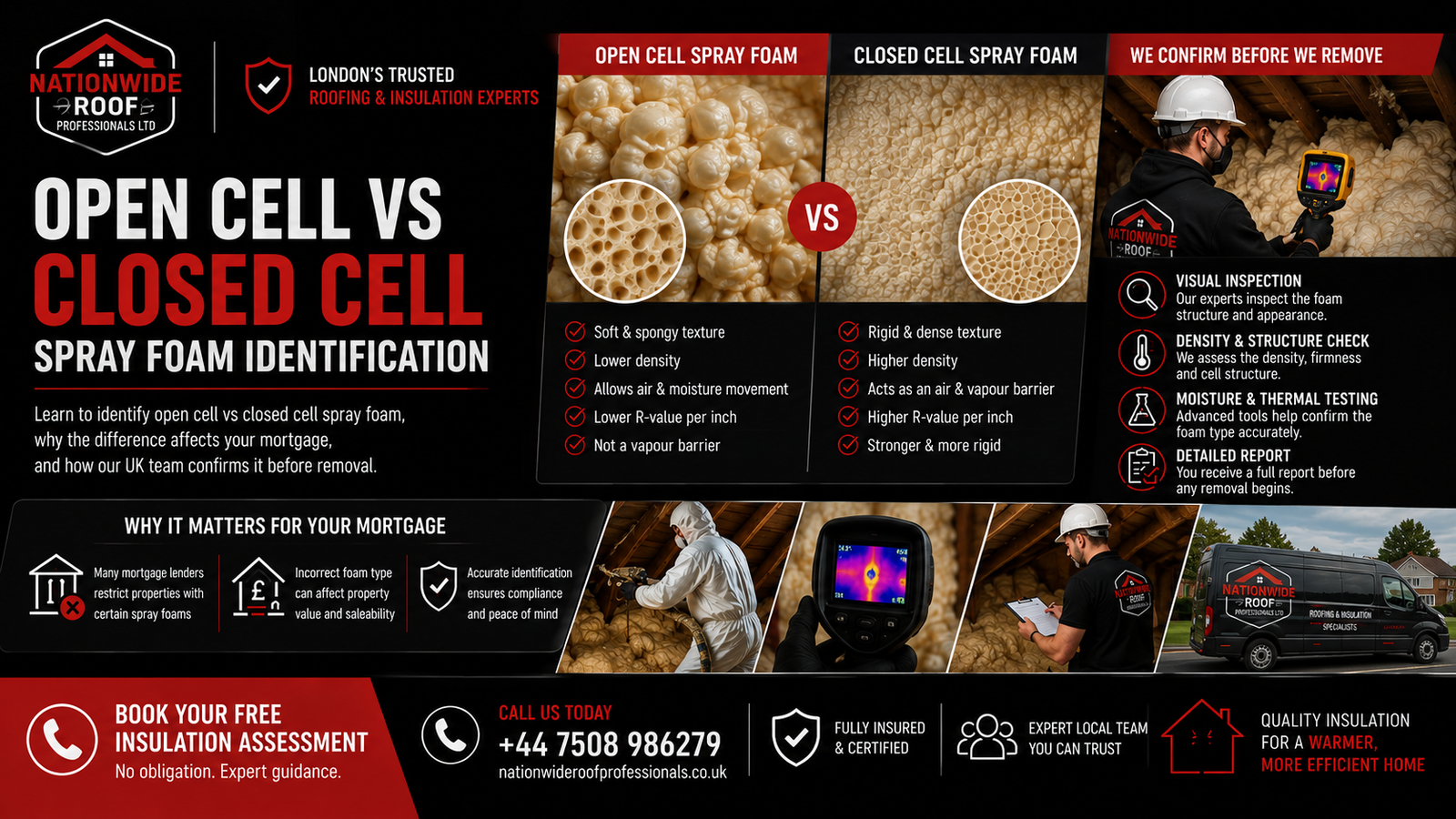
Most homeowners who call about spray foam cannot answer the first question a surveyor will ask them: is it open cell or closed cell. That single detail changes the removal method, the price, and how long the job takes, so getting it right before you book anyone matters more than most people realise.
At Nationwide Roof Professionals we inspect roof spaces across the UK every week, and the confusion between the two foam types is the most common reason homeowners get an inaccurate quote. This guide explains what each type looks like, why lenders treat them differently, and how our team confirms which one you have before we ever pick up a tool.
We wrote this guide because we kept hearing the same story from callers. A neighbour, an estate agent, or a quick search online had already told them what type of foam they had, only for our inspection to find something different once we actually looked. Getting this one detail right at the start saves time, money and unnecessary stress later in the process.
What Open Cell Spray Foam Looks Like
Open cell spray foam is soft, spongy and pale yellow or off white. Press it with a finger and it compresses easily, springing back once you let go. It is applied at a lower density, usually around 0.5 pounds per cubic foot, which is why it feels closer to a soft sponge than a hard shell.
Because the cell structure is open, moisture vapour can pass through it more readily than closed cell foam, though it still restricts the airflow that a cold roof space is designed around. Open cell foam is generally cheaper to install, which is why it was the more common choice among UK spray foam contractors during the boom years between 2005 and 2020.
Removal is usually the more straightforward of the two jobs. Our technicians pull open cell foam away from the timber by hand in large sections, then use stiff wire brushes to clear the residue left in the wood grain. On a typical semi detached loft this takes a single team about four to six hours.
What Closed Cell Spray Foam Looks Like
Closed cell foam is rigid, dense and usually off white or cream in colour. It will not compress under finger pressure and it snaps rather than bends if a small piece breaks off. It is applied at a much higher density, often around two pounds per cubic foot, which is why it feels closer to a hard plastic shell bonded to the timber.
This density is exactly what makes closed cell foam so difficult for surveyors to see through. It bonds tightly to roof timbers and sarking felt, which means any rot, damp or timber decay underneath is completely hidden. That is the core reason lenders and RICS surveyors treat closed cell installations as higher risk during a property survey.
Removal takes considerably longer. We use SDS drills and specialist scraping tools to break the bond between the foam and the timber, working in smaller sections to avoid damaging the rafters and sarking felt underneath. A typical closed cell removal job on the same size property takes a full day or more, which is reflected in the price difference between the two removal types.
Why the Difference Matters for Your Mortgage
UK mortgage lenders became far more cautious about spray foam insulation after the Royal Institution of Chartered Surveyors updated its guidance on how surveyors should treat foam filled roofs. A RICS Home Survey conducted on a property with either type of spray foam present will typically flag it, but closed cell foam creates the bigger problem because the surveyor cannot inspect the timber condition without physically removing sections of the foam.
Open cell foam is sometimes acceptable to some lenders if it can be shown that the roof space is still ventilated and the timbers are in good condition, though this varies significantly by lender. Closed cell foam is far more likely to result in a mortgage being declined or a retention being applied until it is professionally removed and the timbers are inspected.
This is why our reports always state the foam type clearly, along with photographic evidence of the timber condition once the foam has been removed. Surveyors and lenders need this documentation to reconsider a mortgage application, and guessing the foam type incorrectly on a report can delay a property sale by weeks.
Where a lender does not decline the application outright, it is common for them to apply a retention, holding back part of the mortgage funds until the foam is removed and the timbers confirmed sound. This puts pressure on both buyer and seller during a transaction, which is why estate agents increasingly ask about spray foam before a property even goes to survey. Getting ahead of the issue with a professional removal and report, rather than waiting for a survey to flag it, keeps a sale on schedule and avoids last minute price renegotiations.
Common Signs Your Roof Has a Spray Foam Problem
Spray foam does not always announce itself as a problem straight away, which is part of why so many homeowners only discover it when they try to sell or remortgage. A musty smell in the loft, dark staining on any exposed timber edges, or condensation on the underside of roof tiles are all early warning signs worth acting on.
Peeling paint on bedroom ceilings directly below the loft space, cold spots that suddenly turn warm and damp, or a noticeable rise in humidity inside the property during winter months can also point to a ventilation problem caused by foam blocking the natural airflow a pitched roof relies on. None of these signs confirm foam is present, but combined with a loft inspection they build a clear picture of whether removal should be a priority.
If your property was purchased with spray foam already installed, checking the original paperwork from the previous owner or the installer named on any guarantee certificate is a useful first step. Many installers who fitted foam during the 2010s have since ceased trading, which is one of the reasons a fresh professional inspection matters more than an old paper guarantee.
Why Roof Ventilation Matters More Than People Think
A traditional pitched roof is designed with a continuous airflow path running from the eaves to the ridge. This airflow carries moisture vapour out of the roof space before it can condense on cold surfaces and soak into timber. When spray foam is applied directly to the underside of the roof covering, that airflow path is frequently blocked or removed entirely.
Closed cell foam is the bigger concern here because it forms an almost complete seal, trapping any moisture that does get through against the timber with nowhere to escape. Over several years this can lead to slow, hidden decay that is invisible from inside the loft because the foam is covering it. Open cell foam allows more vapour movement but still interrupts the ventilation gaps that building regulations expect a roof to maintain.
Restoring proper ventilation is one of the main reasons removal is recommended even on properties that are not currently being sold or remortgaged. Once the foam is gone, our team can also advise on whether additional roof vents, such as tile vents or a ridge vent system, are needed to bring the roof space back in line with current building guidance.
Comparing Open Cell and Closed Cell Spray Foam
| Feature | Open Cell Spray Foam | Closed Cell Spray Foam |
| Texture | Soft, spongy, compresses easily | Rigid, dense, does not compress |
| Typical density | Around 0.5 lb per cubic foot | Around 2.0 lb per cubic foot |
| Colour | Pale yellow or off white | Off white or cream |
| Moisture vapour | More permeable | Largely impermeable |
| Removal method | Hand pulled, wire brushed | SDS drill, scraped in sections |
| Typical removal time | Four to six hours | One full day or more |
| Mortgage risk | Moderate, lender dependent | High, frequently declined or retained |
| Timber inspection | Usually possible after light clearing | Requires full removal first |
How Our Team Confirms the Foam Type Before Removal
We never quote a spray foam removal job over the phone based on a description alone. Every project starts with a loft inspection, either in person or through photographs the homeowner sends us, so our team can confirm density, colour and bonding before agreeing a price or a removal method.
During the inspection we also check for secondary issues that often hide behind spray foam, including damp staining on the timbers, signs of woodworm, and inadequate roof ventilation that may have contributed to condensation problems in the first place. All of this goes into the written report we hand over once the job is finished, which is designed to satisfy the documentation standards that lenders and surveyors expect.
If you already have a survey report that mentions spray foam but does not specify the type, send it to our team before booking any removal work. Misidentifying the foam type is the single biggest cause of incorrect quotes in this industry, and it is a problem we can usually solve with a short phone call and a few clear photographs of your loft space.
Once removal is complete, most homeowners choose to reinsulate the loft with a product that keeps the roof space properly ventilated, rather than repeating the mistake that led to the original foam problem. We cover the main options, including SuperFoil, ThermaQuilt and EcoWool, in our separate guide to loft insulation after spray foam removal, so you are not left with a bare, cold roof space while you decide what to do next.
Spray Foam Removal Across the UK
We carry out open cell and closed cell removal for homeowners across the country, from our base in Sutton, Surrey through to London, Reading, Bristol, Milton Keynes and Gloucester, alongside many other towns and cities. Roof construction varies regionally, older Victorian terraces common across London and the South East often have different rafter spacing and sarking arrangements to the newer builds we see around Milton Keynes and Reading, and our team adjusts the removal approach accordingly.
Wherever you are based, the same process applies. We confirm the foam type, agree a fixed price, and provide the photographic and written documentation your surveyor or lender needs. You can see examples of completed roof and insulation projects on our completed projects.
Homeowners in and around Sutton and the wider London boroughs often have terraced or semi detached properties built before 1980, where original sarking felt is thinner and more prone to damp once ventilation is blocked. Further out toward Reading and Milton Keynes we more commonly find 1980s and 1990s builds with trussed roofs, where foam was frequently sprayed directly onto factory made trusses rather than traditional rafters, which changes how carefully the removal team needs to work around the timber joints. In Bristol and Gloucester we see a mix of both, along with older stone built properties where roof ventilation was never generous to begin with. Whatever the construction type on your property, our team has the experience to adapt the removal method to suit it.
Frequently Asked Questions
Can I identify the spray foam type myself before calling a contractor? You can get a reasonable idea by pressing the foam gently. If it compresses like a sponge it is likely open cell, and if it feels hard and rigid it is likely closed cell. A professional inspection is still the only reliable way to confirm this before removal begins.
Is closed cell spray foam always more expensive to remove than open cell? In almost every case, yes. Closed cell foam bonds more tightly to the timber and takes longer to remove safely, which is reflected in the labour time and therefore the price.
Will removing spray foam damage my roof timbers? When removal is carried out correctly the timbers underneath are not damaged. Our technicians use methods matched to the foam type specifically to protect the sarking felt and rafters, and any pre existing timber issues are documented separately from the removal work itself.
Do all UK lenders refuse mortgages on properties with spray foam insulation? Not all lenders take the same position, and policies can change. Some will lend against open cell foam if the roof space is ventilated and timbers are sound, while closed cell foam is far more commonly declined. Speaking to a mortgage broker alongside getting the foam professionally assessed is the safest approach.
How long does a full spray foam removal and report take? Most residential lofts are completed in a single day for open cell foam, and one to two days for closed cell foam depending on the size of the roof space. Your written report is typically provided within a few working days of the removal being completed.
How much does spray foam removal actually cost? Price depends heavily on which type of foam is present, the size of the roof space and how accessible it is. Our guide to what happens during spray foam removal explains how we scope a job before pricing it, or get in touch for a free, fixed quote based on your property.
What should I do if a removal company cannot tell me the foam type over the phone? Treat this as a warning sign rather than normal practice. A reputable contractor will always want to inspect photographs or the loft itself before quoting, because pricing a job blind leads to inaccurate quotes and disputes later. Our guide on avoiding rogue spray foam removal companies covers more warning signs to watch for.
Knowing which type of spray foam is sitting above your ceiling changes everything about the job ahead, from the price you should expect to pay through to how a lender will view your property. If you are unsure what you are dealing with, our team can usually tell from a short phone call and a handful of photographs, and we will always give you an honest answer rather than the most expensive one. Get in touch through our contact page for a free assessment of your loft space.