Loft Insulation After Spray Foam Removal: SuperFoil, EcoWool and Cavity Wall Explained
Once spray foam has been professionally removed from a roof, many homeowners are left with a bare, cold loft space and a decision they were not expecting to make. The foam that caused the original problem was, in most cases, installed to solve a genuine issue, poor energy efficiency and high heating bills, so leaving the loft uninsulated is rarely the right long term answer.
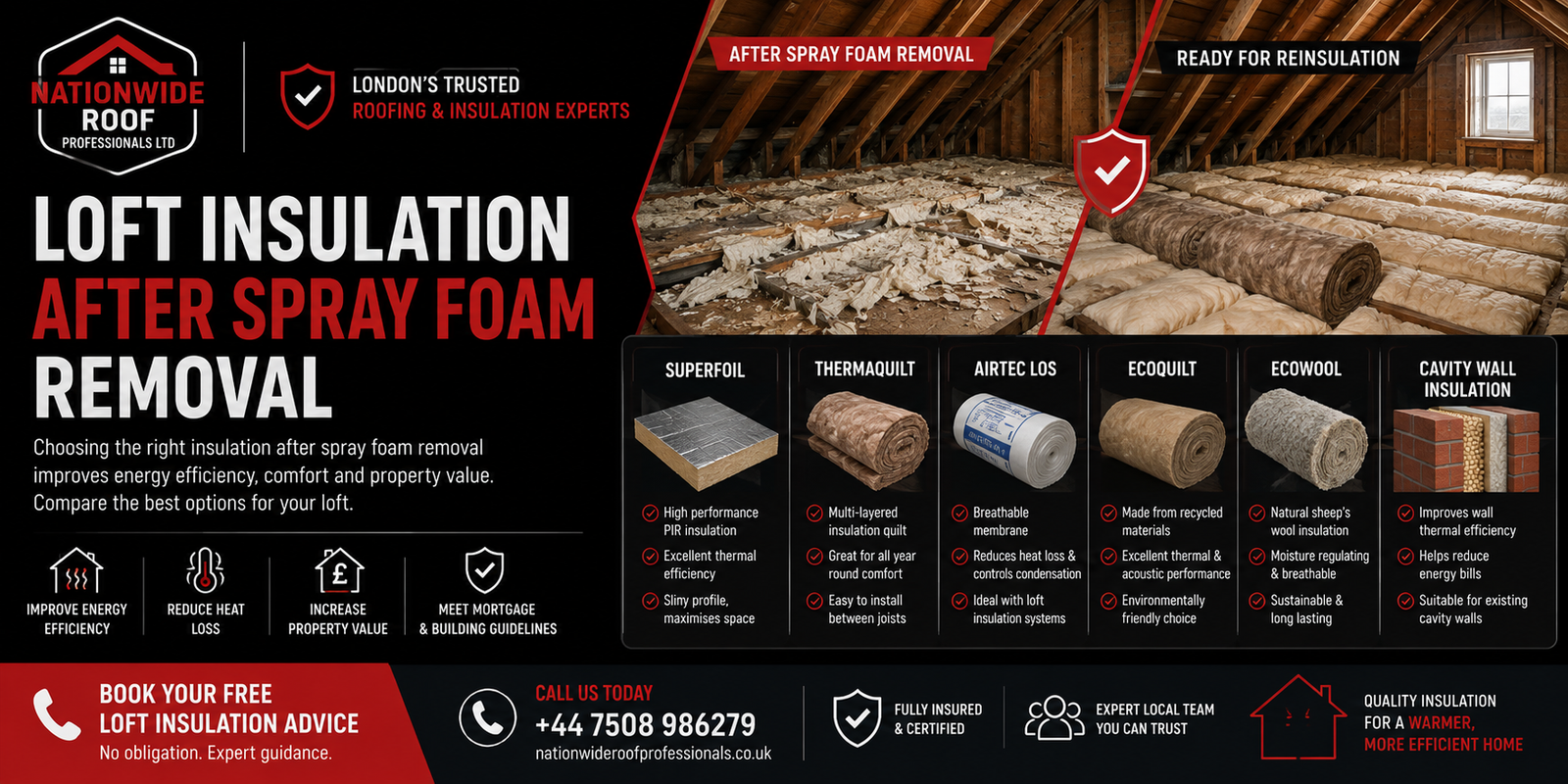
The good news is that modern insulation options give you the same energy efficiency benefits spray foam promised, without blocking the ventilation a roof space needs. This guide walks through the main options we install after a removal job, including SuperFoil, ThermaQuilt, AirTec LOS, EcoQuilt, EcoWool and cavity wall insulation, so you can choose the right fit for your property and budget.
If you are still at the stage of confirming what type of foam you have and what removal will involve, our earlier guides on identifying open cell and closed cell spray foam and what to expect during spray foam removal cover that ground in detail. This guide picks up where those leave off, once the roof space is cleared and ready for new insulation.
Why Reinsulating Matters After Removal
A newly cleared loft space, while safer for the roof timbers, offers no thermal protection at all, meaning heating bills can actually rise in the short term if the space is left as it is. Beyond cost, an uninsulated loft also increases the risk of condensation forming on the underside of the roof covering during colder months, since warm, moist air from the house below can rise unchecked into the cold roof space.
Choosing the right replacement insulation is also an opportunity to correct the ventilation mistake that likely contributed to problems with the original spray foam. Every option below is designed to work with a properly ventilated roof space rather than sealing it, which is the fundamental difference between these products and the foam that was removed.
SuperFoil Insulation
SuperFoil is a multi layer reflective insulation, combining foil layers with a foam core to reflect radiant heat back into the living space while still allowing the roof timbers to breathe. It is a popular choice for lofts with limited headroom, since it achieves strong thermal performance in a relatively thin layer compared to bulkier alternatives.
Installation involves fixing the foil layers between or over the rafters, with a small air gap maintained on either side to allow the reflective properties to work effectively. It is a good option for loft conversions or rooms in the roof, where maximising usable headroom is a priority alongside thermal performance.
ThermaQuilt Insulation
ThermaQuilt is a flexible quilted insulation designed for straightforward installation across loft floors or between rafters. It combines good thermal performance with sound insulation benefits, making it a popular choice for homeowners who also want to reduce noise transfer between a loft conversion and the rooms below.
Because it is supplied in rolled quilt form, ThermaQuilt is relatively quick to fit across large, open loft areas, which can help keep labour costs down compared to more specialist products. It performs well as a straightforward, reliable replacement for homeowners who simply want a properly insulated, ventilated loft floor after foam removal.
AirTec LOS Insulation
AirTec LOS is designed specifically to maintain a clear air gap alongside the insulation layer, directly addressing the ventilation problems that spray foam is most commonly criticised for. This makes it a particularly well suited option for properties where a survey previously flagged ventilation concerns, since the product is engineered around maintaining airflow rather than treating it as an afterthought.
This type of insulation is often specified where a roof has previously suffered from condensation or damp related issues, giving homeowners confidence that the same problem is far less likely to recur once the new insulation is fitted correctly.
EcoQuilt and EcoWool Insulation
EcoQuilt and EcoWool are both softer, more traditional insulation materials, with EcoWool in particular offering a natural fibre option for homeowners who prefer a more environmentally conscious material. Both are effective at loft floor level, sitting between and over the joists to reduce heat loss through the ceiling below while leaving the roof space itself properly ventilated above.
These options tend to suit homeowners who are insulating at ceiling joist level rather than converting the loft into usable space, since they are less suited to rafter level installation in rooms with a finished, habitable roof space. They remain among the most cost effective insulation choices for a straightforward, unconverted loft.
Cavity Wall Insulation
While not a direct like for like replacement for roof level spray foam, many homeowners take the opportunity of a loft insulation upgrade to also review whether their external walls are insulated. Cavity wall insulation fills the gap between the inner and outer leaf of a cavity wall with insulating material, reducing heat loss through the walls in the same way loft insulation reduces heat loss through the roof.
Combining a fresh loft insulation upgrade with cavity wall insulation, where suitable for the property’s construction, often delivers a more noticeable overall improvement in comfort and heating costs than addressing the loft alone, since walls typically account for a significant proportion of total heat loss in an uninsulated property.
Comparing the Main Options
| Product | Best Suited To | Key Benefit |
| SuperFoil | Low headroom lofts, loft conversions | Strong thermal performance in a thin layer |
| ThermaQuilt | Large open loft floors | Quick installation, added sound insulation |
| AirTec LOS | Roofs with previous ventilation or damp issues | Maintains a dedicated air gap |
| EcoWool | Unconverted lofts, natural material preference | Effective, environmentally conscious fibre |
| EcoQuilt | Unconverted lofts, straightforward budgets | Cost effective floor level performance |
| Cavity Wall Insulation | Properties with unfilled cavity walls | Reduces heat loss through external walls |
How to Choose the Right Option for Your Property
The right choice depends on whether your loft is used purely for storage or has been converted into habitable space, how much headroom you have to work with, and whether ventilation or damp issues were identified during the spray foam removal. Our team discusses all of this with you once removal is complete and the roof timbers have been inspected, so the recommendation is based on the actual condition of your roof rather than a generic default.
Budget is naturally a factor too, and we always provide options across different price points rather than steering every homeowner toward the most expensive product. In many cases a straightforward EcoWool or EcoQuilt installation at joist level provides excellent value for an unconverted loft, while SuperFoil or AirTec LOS earn their higher price in converted spaces or on roofs with a documented ventilation history.
We also factor in how the property is likely to be used over the coming years. A family expecting to convert the loft into a bedroom or home office within a few years may prefer to invest in SuperFoil from the outset, even if the loft is currently used only for storage, since it avoids paying for a second insulation upgrade later when the conversion happens. A homeowner with no plans to alter the loft space typically finds better value in the simpler floor level products.
Why Choosing the Wrong Insulation Can Repeat the Original Problem
One of the most important lessons from the wider spray foam issue is that insulation choice matters as much as insulation coverage. Spray foam was popular in part because it promised a single product that sealed and insulated a roof in one step, but that sealing effect is exactly what caused ventilation and hidden timber problems for so many homeowners.
Choosing a replacement product without considering ventilation risks recreating a milder version of the same issue. For example, fitting insulation too tightly against rafters without maintaining the recommended air gap can still restrict airflow even with a breathable product, since the gap itself is what allows moisture laden air to escape the roof space. This is why our installers always measure and confirm the air gap during fitting, rather than treating it as a fixed assumption.
Loft boarding is another area where mistakes commonly happen. Boarding directly on top of insulation without appropriate loft leg spacers compresses the insulation beneath it, significantly reducing its thermal performance in exactly the areas where boarding is fitted. If you plan to use the loft for storage after reinsulation, mention this when the work is planned so appropriate spacers and boarding can be included from the outset.
Loft Boarding and Loft Ladders After Reinsulation
Many homeowners use the opportunity of a full loft clearance and reinsulation to also improve practical access to the space. Loft boarding fitted correctly, raised above the new insulation on proper support legs, allows the loft to be used for storage without compressing the insulation or creating cold bridging points where boards touch joists directly.
A new loft ladder is often fitted at the same time, replacing older, less stable ladders or simple hatch access with a safer, more convenient folding or telescopic ladder system. This is a relatively small addition to a reinsulation project but significantly improves how usable the space becomes day to day, particularly for households that rely on loft storage for seasonal items or belongings.
Combining these elements, insulation, boarding and ladder access, into a single project also tends to be more cost effective than tackling them separately over time, since our team is already working in the loft space and can complete all three elements in a coordinated visit.
Real World Example: From Removal to Reinsulation
A recent project for a homeowner in Reading illustrates how this process typically works in practice. Closed cell spray foam was removed from a four bedroom detached property ahead of a remortgage, revealing generally sound timbers with some minor damp staining near the eaves on one side of the roof. Once the timbers had dried out over several days, our team returned to fit AirTec LOS insulation specifically because of the ventilation history, along with loft boarding and a new loft ladder in the same visit.
The homeowner received a written report confirming both the successful spray foam removal and the new insulation specification, which their mortgage lender accepted without further query. This combined approach, addressing the immediate mortgage requirement while also solving the underlying ventilation and storage needs, is typical of how most of our reinsulation projects are planned once removal is complete.
Building Regulations and Energy Efficiency
Current building regulations set minimum thermal performance standards for loft insulation, and any reinsulation work should meet or exceed these standards rather than simply matching what was there before the spray foam was installed. Meeting these standards is also relevant if you plan to sell the property in future, since an Energy Performance Certificate assessment will reflect the insulation standard achieved.
Guidance on current minimum standards and recommended insulation depths is available through the Energy Saving Trust, which is a useful independent reference point alongside advice from your installer. We design every reinsulation project to meet current regulations as standard, not as an optional upgrade.
Frequently Asked Questions
Can I install new insulation myself after spray foam has been professionally removed? Some products, particularly quilt insulation laid at joist level, are suitable for competent DIY installation. However, we recommend a professional installation if ventilation issues were identified during removal, since correct detailing around eaves and ridge vents is essential to avoid repeating the original problem.
How soon after removal should I reinsulate the loft? There is no strict deadline, but leaving a loft uninsulated for an extended period increases both heating costs and the risk of condensation forming in the newly cleared roof space. Most homeowners choose to reinsulate within a few weeks of removal being completed.
Will new insulation affect my mortgage or property survey in the same way spray foam did? No. The products discussed in this guide are all standard, well established insulation materials that surveyors and lenders are familiar with and do not treat as a risk factor, unlike spray foam applied directly to the roof structure.
Is cavity wall insulation suitable for every property? No. It is only suitable for properties built with a cavity wall construction, and even then a survey is needed to confirm the cavity is in suitable condition, since damp or debris within the cavity can make insulation unsuitable without remedial work first.
Does new loft insulation come with a guarantee? Reputable installers provide product and installation guarantees, and we provide documentation for every reinsulation project we complete, giving you a clear record of what was installed and when, useful for future EPC assessments or property sales.
Choosing the right replacement insulation is the final step in properly resolving a spray foam problem, turning a bare, cold loft back into an energy efficient part of your home without repeating the ventilation mistakes of the original installation. If you have recently had spray foam removed, or are planning removal soon, our team can advise on the best insulation option during the same visit. Get in touch through our contact page, or learn more about our full range of insulation services on our insulation. If you have not yet booked removal, our guide on avoiding rogue spray foam removal companies is worth reading first.