Roof Replacement in the UK: When You Need One and What to Expect
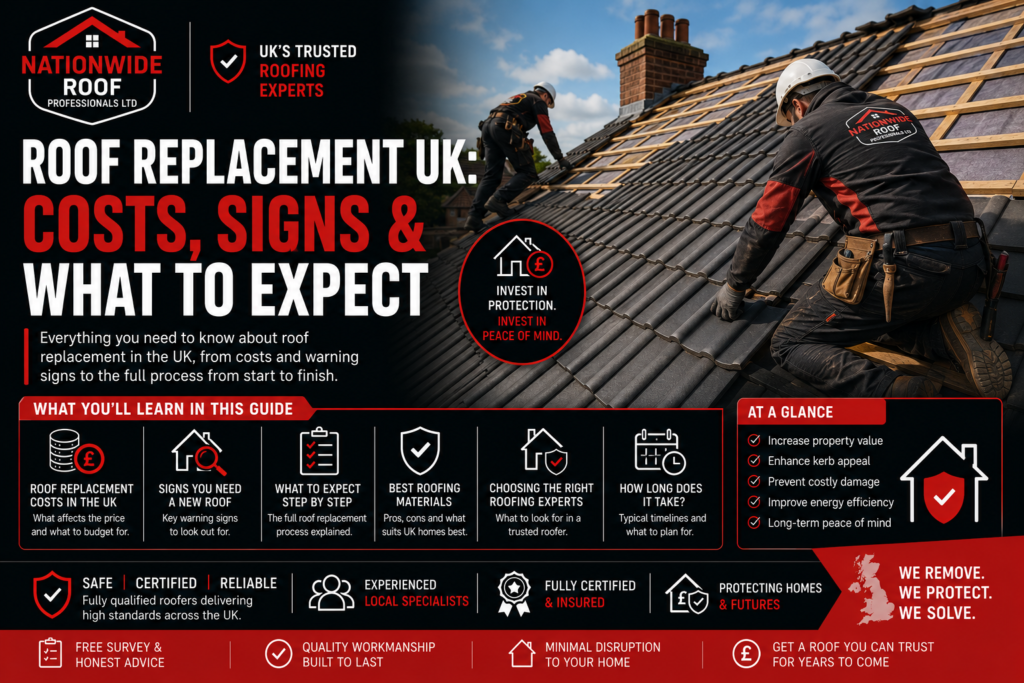
Roof Replacement in the UK: When You Need One and What to Expect A roof replacement is one of the largest single investments a homeowner makes. Carried out correctly, a new roof gives 30 to 50 years of protection with minimal maintenance. Choose the wrong contractor or the wrong materials and you face problems within two years. This guide covers the warning signs that a full replacement is needed, realistic UK costs, tile and slate options, and the questions to ask any roofing contractor before signing a contract. Signs That Your Roof Needs Replacing Rather Than Repairing Age is the first variable. Concrete interlocking tiles have a typical lifespan of 30 to 50 years. Clay tiles last 50 to 80 years. Natural slate can last 80 to 100 years, though fixings, battens and underlay will need replacement well before the slates wear out. If your roof is approaching or past these thresholds, repair costs will accumulate faster than replacement. Multiple leaks in different locations are a strong replacement signal. One leak is localised. Three or four leaks over two years suggest the underlying felt or structure is deteriorating across a broad area. At this point, patching typically costs more over five years than a single quality replacement. A sagging or visibly uneven roofline indicates structural failure beneath the covering. Rafter decay, ridge board splitting or purlin movement all manifest as a visible departure from a clean straight roofline. This needs immediate professional assessment. Our roofing team carries out full structural inspections as part of every re-roof project. What a Full Roof Replacement Involves A complete roof replacement begins with stripping all existing tiles or slates down to the bare roof structure. This is the point at which the actual structural condition is revealed, which is why contractors who quote a fixed price without first stripping the existing covering are making assumptions they cannot support. Every rafter, purlin and ridge board is inspected for signs of moisture, rot or insect damage. Compromised timbers are sistered or replaced before the new covering goes on. New breathable underlay is laid across the full roof area. New treated battens are fixed over the underlay and tiles or slates are laid from the eaves to the ridge. Ridge tiles are fitted with a dry fix mechanical ridge system as standard on any quality re-roof project. Dry fix ridges do not crack or fail as mortar ridges do, and they do not require re-pointing. Flashings, valley gutters and any associated leadwork are all replaced as part of the project. Our full re-roof service includes a written scope of works before any commitment is made. Roof Replacement Costs in the UK Property Type Concrete Tile Clay Tile Natural Slate 2 bed terrace 4,500 to 7,000 GBP 6,500 to 9,500 GBP 8,000 to 13,000 GBP 3 bed semi detached 6,000 to 10,000 GBP 9,000 to 14,000 GBP 11,000 to 18,000 GBP 4 bed detached 9,000 to 16,000 GBP 13,000 to 20,000 GBP 16,000 to 28,000 GBP Scaffolding (add to above) 700 to 2,000 GBP 700 to 2,000 GBP 700 to 2,000 GBP Structural repairs identified during stripping are typically quoted separately because their extent cannot be known until the covering is removed. Always ask contractors how additional work is authorised and documented before signing any contract. Choosing the Right Roofing Material Concrete interlocking tiles offer the best cost to durability ratio for most UK properties. They are available in a wide range of profiles, colours and finishes, have a lifespan of 30 to 50 years, and replacement tiles are straightforward to source. Natural clay tiles carry a longer lifespan and offer a warmth of appearance that concrete cannot replicate. For period properties across London and Surrey, clay is often the appropriate choice both aesthetically and for planning purposes. Natural Welsh or Spanish slate delivers exceptional longevity, typically 60 to 80 years for quality material. It suits period properties where the original covering was slate and where conservation area requirements specify like for like replacement. Fibre cement slate closely replicates the appearance at significantly lower cost. Roofing and Loft Insulation: The Right Time to Combine A full roof replacement is the most practical time to also upgrade loft insulation. The roof space is fully accessible, the structure is visible, and insulation can be installed to exactly the correct specification without a second period of disruption. We regularly combine loft insulation upgrades with re-roof projects. If spray foam is present, our spray foam removal service can be sequenced to complete before the new covering is installed, giving a complete roof system upgrade in a single project. Roof Replacement in London and Surrey Properties across London, Surrey and the wider South East present specific roofing challenges. Victorian and Edwardian terraces in Croydon, Sutton, Wimbledon, Clapham, Guildford, Kingston and Woking often have complex rooflines with hips, valleys, dormers and party wall abutments. These details require experienced roofers who understand how period properties are constructed. Conservation area requirements in many London boroughs and Surrey districts specify particular tile types or finishes. Our team works within these constraints as a matter of course, advising on appropriate materials before any specification is finalised. How to Avoid a Poor Roofing Contractor Scaffold must be included or clearly itemised. Any contractor offering to carry out a full re-roof without scaffolding should be declined immediately. Working at height regulations make it mandatory for work of this nature. Get a written specification before signing anything. Materials, tile type and specification, underlay, ridge system, flashings, waste disposal and guarantee terms should all be in writing. Check for public liability insurance and ask to see the certificate. Request to see comparable completed work or speak to previous customers. Our completed projects page shows examples of our work across London and Surrey. Frequently Asked Questions about Roof Replacement Does a new roof add value to a property? Yes. A new roof removes one of the most significant buyer concerns in a transaction, supports mortgage approval and in most cases adds
How to Improve Your EPC Rating in UK 2026: What Actually Works
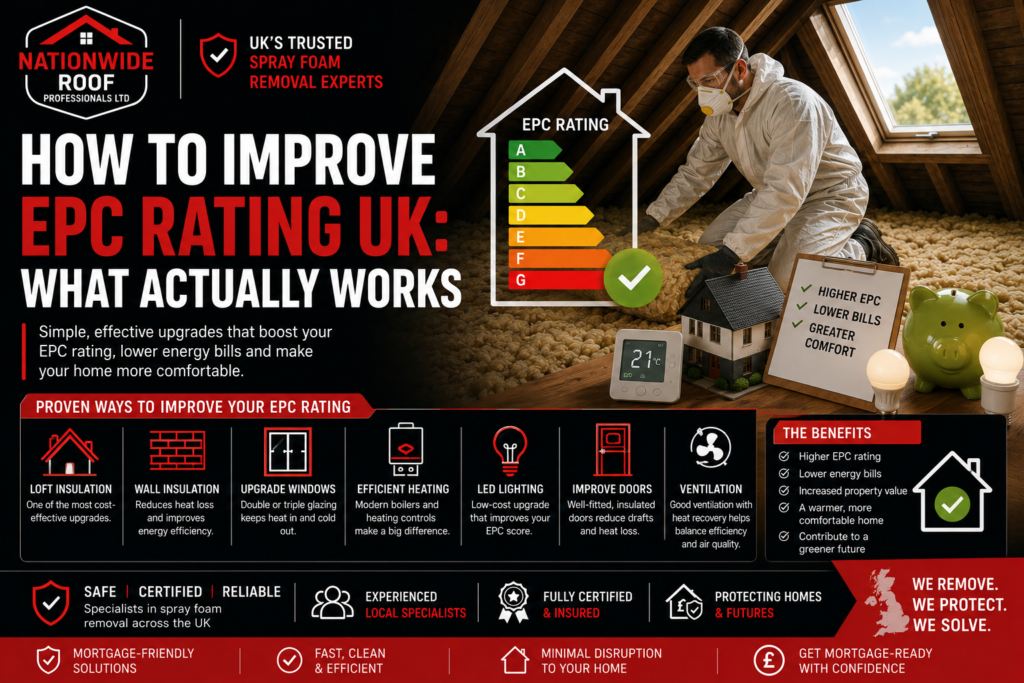
How to Improve Your EPC Rating in UK 2026: What Actually Works Your EPC rating now has a direct impact on your ability to sell, rent and remortgage. If your property is below band C you are already facing buyer pushback, tightening rental compliance rules, and higher mortgage costs. Improving your EPC is not complicated but the order in which you tackle measures determines how much improvement you actually get for the money you spend. This guide takes you through the highest impact actions first. Why EPC Ratings Matter More Than Ever in 2026 The UK government’s net zero trajectory means EPC requirements are tightening on a consistent schedule. For rental properties, the minimum EPC target is band C by 2028. Many mortgage products now reserve preferential rates for properties above band C. Buyers and their solicitors increasingly flag properties rated D or below. The average UK home sits at band D. Moving from D to C is achievable in most properties without structural renovation. Moving from E to C often requires a combination of two or three measures. Understanding which measures produce the biggest rating gain for your specific property type is the starting point. The UK government’s Simple Energy Advice service provides a free assessment of what measures apply to your property and the estimated EPC improvement from each. Step 1: Loft Insulation Upgrade (Highest Single Gain) For the vast majority of UK homes, loft insulation is the single highest return EPC improvement available. Heat loss through the roof accounts for up to 25% of total home heat loss. Upgrading to 270mm of compliant breathable insulation delivers a direct and measurable improvement to the U value calculation that drives EPC scores. For most homes, this single measure achieves a one band improvement. For homes with very poor current insulation, the gain can be larger. Our full range of loft insulation products is detailed on our insulation service, including EcoWool, SuperFOIL and PIR board for specialist applications. Measure Typical EPC Gain Approximate Cost Priority Loft insulation upgrade to 270mm 1 to 2 bands 300 to 1,000 GBP Highest Cavity wall insulation 1 band 400 to 1,200 GBP High Spray foam removal and replacement 1 to 2 bands 2,000 to 5,500 GBP Essential if present Heating system upgrade (boiler replacement) 1 band 2,000 to 4,000 GBP Medium Draught proofing Less than 1 band 100 to 400 GBP Low Double or triple glazing Less than 1 band 3,000 to 10,000 GBP Low to medium Step 2: Remove Spray Foam Insulation if Present Spray foam insulation that is degraded, moisture damaged or poorly installed performs significantly worse thermally than its nominal specification suggests. In many cases, properties with spray foam score lower on EPC assessments than they should because the foam has failed to maintain its original performance. Beyond the EPC calculation, spray foam is now a direct barrier to mortgage approval in most UK lending. Removing it and replacing it with compliant breathable insulation both improves the EPC and restores mortgageability simultaneously. This makes spray foam removal one of the most financially impactful single actions a homeowner can take. Our spray foam removal service covers the full process including structural assessment, timber treatment and completion certification. Step 3: Cavity Wall Insulation For post 1920s properties with an unfilled cavity, professional cavity wall insulation reduces heat loss through external walls by up to 35%. This is the second largest source of heat loss after the roof, and produces a significant EPC improvement that compounds the effect of loft insulation. Suitability for cavity fill depends on cavity width, external wall condition, and the property’s exposure to driving rain. Our cavity wall insulation service includes a pre installation survey to confirm suitability. The Property Care Association provides guidance on cavity wall insulation standards and what a compliant installation should include. Step 4: Heating System Improvements The EPC methodology penalises older, lower efficiency boilers significantly. A boiler rated below 90% efficiency, or a system without thermostatic radiator valves and a programmable room thermostat, will score meaningfully lower than a modern condensing system with full controls. Boiler replacement is typically the most expensive measure on the list but its EPC impact is substantial and it produces immediate energy bill savings. Heat pumps score very favourably on EPC calculations because they use electricity to move heat rather than burning fuel, which under the current EPC methodology produces a high rating. Roofing and EPC: The Connection Roof condition directly affects EPC rating in ways beyond just insulation. A roof with significant air leakage at ridge or verge junctions, failed felt allowing cold air to reach the insulation, or degraded tiles creating large temperature differentials will underperform regardless of the insulation below. A full roof replacement using modern breathable underlay and dry fix ridge systems improves airtightness and delivers a more consistent thermal envelope. Properties where the roof is clearly past its service life benefit from combining re-roofing with insulation upgrading in a single project. EPC Improvements in London and Surrey Properties London and Surrey present specific EPC improvement challenges. Period properties including Victorian and Edwardian terraces, often found in Croydon, Sutton, Kingston, Wimbledon, Guildford and Woking, have solid or part solid walls, constrained loft spaces, and original single glazing. This limits how far EPC can be improved purely through loft insulation and cavity wall work. For these property types, the combination that typically delivers the most practical improvement is: loft insulation upgrade using SuperFOIL or PIR for constrained rafter spaces, spray foam removal where present, and boiler system controls improvement. Contact our team for a site specific assessment across the London and South East area. Frequently Asked Questions about EPC Improvement How quickly can an EPC rating be improved? Insulation improvements and spray foam removal can be completed and a new EPC assessment commissioned within days. There is no mandatory waiting period between installation and reassessment. Does removing spray foam improve EPC? Yes, particularly when replaced with compliant breathable insulation at the correct depth. In properties
Does Loft Insulation Actually Save Money? Real UK Numbers
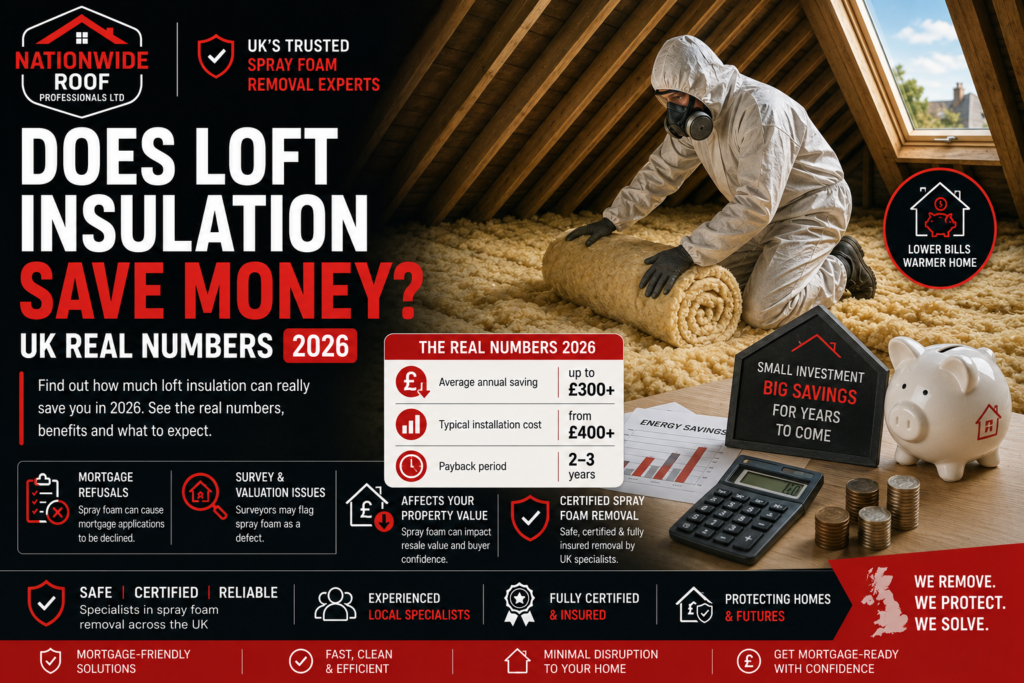
Does Loft Insulation Actually Save Money? Real UK Numbers Loft insulation is marketed as a guaranteed money saver. The honest answer is more specific: the right type, correctly installed to the right depth, saves real money with a measurable payback period. The wrong type or incorrect installation can waste the investment entirely. This guide gives you the actual UK numbers and the product comparison you need before making a decision. How Much Heat Escapes Through an Uninsulated Loft Up to 25% of a home’s heat escapes through an uninsulated or poorly insulated roof. On a typical UK annual heating bill of 1,800 GBP, that is 450 GBP leaving through the ceiling every year. Most UK homes have around 100mm of loft insulation installed when the current UK building regulation recommendation is 270mm. That gap between actual and recommended is costing homeowners money every single winter. The Energy Saving Trust estimates that a semi detached house with no loft insulation can save between 150 and 300 GBP per year by upgrading to a compliant depth. For a detached house the saving is higher. Home Type Annual Saving (Estimated) Installation Cost Payback Period Mid terrace house 115 to 165 GBP 300 to 500 GBP 2 to 4 years Semi detached house 155 to 255 GBP 400 to 700 GBP 2 to 4 years Detached house 215 to 335 GBP 600 to 1,000 GBP 2 to 4 years Flat (top floor) 95 to 145 GBP 200 to 400 GBP 2 to 3 years These figures are based on upgrading from no insulation to 270mm compliant depth. Homes upgrading from partial insulation (around 100mm) will see proportionally smaller savings but still achieve payback within three to five years in most cases. EcoWool Mineral Wool: Best Value for Standard Loft Spaces EcoWool mineral wool is the most widely installed loft insulation product in the UK and the most cost effective for standard cold loft applications. At 270mm depth it delivers an R value of approximately 7.0 m2K/W, meeting current UK building regulations comfortably. Critically, EcoWool is breathable. Moisture vapour passes through it naturally, exits via soffit ventilation, and the roof structure stays dry. This is the opposite of spray foam, which traps moisture and causes the timber and felt deterioration described on our spray foam removal page. EcoWool is the default product for most residential cold loft installations. View our EcoWool insulation service for specifications and coverage. SuperFOIL: Best for Tight Spaces and Warm Roofs SuperFOIL is a multifoil insulation product that delivers high thermal performance from a fraction of the thickness of mineral wool. Where loft headroom is limited, where the roof pitch makes standard roll installation impractical, or where a warm roof configuration is required, SuperFOIL is frequently the right choice. It is particularly relevant in Victorian and Edwardian properties common across London and Surrey, where constrained rafter spaces make mineral wool installation at the required depth impractical. At 25 to 50mm thickness, SuperFOIL achieves thermal performance comparable to a much thicker mineral wool installation. See our SuperFOIL insulation service for technical specifications. PIR Board: Highest Performance Per Millimetre PIR (polyisocyanurate) rigid insulation board offers the highest thermal performance per millimetre of any commonly used loft insulation material. It is specified where building regulations require a specific U value to be achieved in a limited depth, such as rafter level installations in loft conversions or flat roof warm roof systems. PIR is not the right choice for every application. Its cost per square metre is significantly higher than mineral wool and it requires careful installation to achieve continuous coverage without cold bridges. For the applications where it is appropriate, nothing else performs as well in the same depth. ThermaQuilt and AirTec LOS: Specialist Breathable Systems Both ThermaQuilt and AirTec LOS are multifoil systems that combine thermal resistance with active moisture management. They are particularly well suited to refurbishment projects where depth is restricted and moisture control is a priority alongside thermal performance. In properties with existing condensation problems, or where spray foam has recently been removed and the roof structure is being restored to full health, these products offer a technically sound solution that addresses multiple problems simultaneously. Will Loft Insulation Cause Damp or Condensation? This concern comes up frequently and deserves a direct answer. Properly installed breathable insulation does not cause damp. The keyword is breathable. Products including EcoWool, SuperFOIL, ThermaQuilt and AirTec LOS all allow moisture vapour to pass through naturally. Installed with correct soffit clearance and maintained soffit ventilation, they actively help manage the moisture balance in a roof space rather than trapping it. The insulation products that do cause moisture problems are non breathable ones, most notably spray foam. If you are experiencing roof damp and have spray foam present, the foam is almost certainly contributing. Our spray foam removal service addresses this directly. EPC Ratings and Loft Insulation Upgrading from minimal to compliant loft insulation typically produces a one to two band improvement in EPC rating. This has direct financial implications in three specific scenarios: Selling. EPC band C is increasingly expected by buyers. Lower rated properties attract lower offers and sometimes struggle with buyer financing. Renting. Minimum EPC requirements for rental properties are tightening under current government direction. Landlords below band C face growing compliance pressure. Remortgaging. Green mortgage products now offer preferential rates for properties above EPC band C, making insulation investment directly linked to mortgage cost. The government EPC guidance outlines what drives EPC ratings. Loft insulation consistently appears as the single highest impact measure for most UK home types. Loft Boarding and Insulation: Getting Both Right Many homeowners want loft storage as well as insulation. Laying standard boards directly on top of mineral wool compresses it and destroys up to 60% of its thermal performance. The correct approach uses raised boarding legs that lift the platform above the insulation, keeping it fully uncompressed and fully performing. Our loft boarding service is always designed around the installed insulation depth, whether fitted as part
Spray Foam Mortgage Problems UK: Why Lenders Refuse and What Fixes It
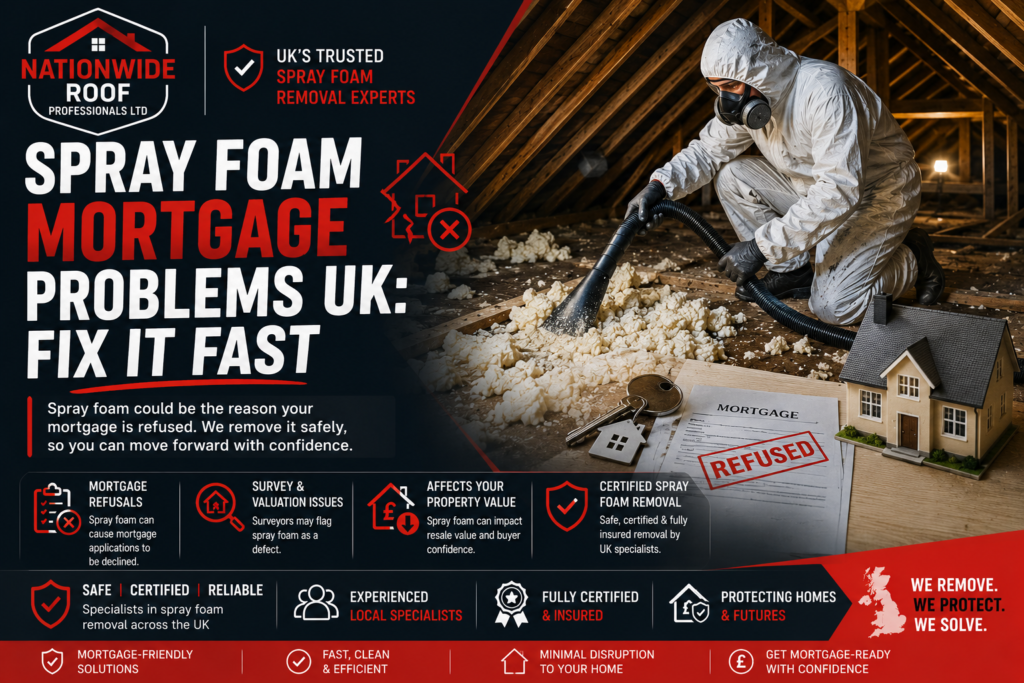
Spray Foam Mortgage Problems UK: Why Lenders Refuse and What Fixes It Spray foam mortgage problems in the UK are now affecting thousands of transactions every year. If your mortgage application has been declined because of spray foam insulation, or if a surveyor has flagged it in a property you are buying or selling, you need accurate information fast. This article explains precisely what causes the refusal, which lenders are affected, and the one action that resolves it in most cases. Why Spray Foam Causes Mortgage Problems in the UK Mortgage lenders rely on surveyors to certify the structural condition of a property before lending. When spray foam insulation is present in the roof structure, RICS surveyors are unable to properly inspect the underlying timbers, felt or structural members. The foam physically conceals the condition of the roof. A surveyor who cannot inspect cannot certify. A lender who receives an inconclusive report has no choice but to decline or impose conditions. Since RICS formalised its guidance on spray foam in 2022, this has become routine across all major UK lenders. Lender Position on Spray Foam Solution Accepted Halifax Declines or conditions lending Professional removal plus completion certificate Nationwide Declines on standard products Professional removal plus completion certificate Barclays Requires specialist valuation or declines Professional removal plus completion certificate Santander Declines in most cases Professional removal plus completion certificate NatWest Flags and conditions Professional removal plus completion certificate Most high street lenders Treat as standard risk flag Completion certificate from specialist contractor The pattern is consistent. Removal followed by a professional completion certificate is the standard accepted route back to mortgageability. Finding a specialist lender who ignores the foam is a workaround, not a solution. The problem will resurface when the buyer sells. What the Completion Certificate Does Not all removal contractors issue a completion certificate that lenders accept. The certificate must confirm specific things to satisfy RICS surveyors and mainstream lenders: Foam type identified and professionally removed. The contractor must confirm the foam type, the removal method used, and that all foam material has been cleared. Full structural inspection carried out. Every visible timber assessed for moisture, rot, and structural integrity. Required treatment completed. Fungicide treatment, wood hardener, and timber replacement where identified. Compliant insulation installed. Breathable replacement insulation fitted to UK building regulation standards, with depth and product specified. Contractor details and insurance. Fully insured specialist contractor details included for lender verification. Our certificates have an established track record of clearing mortgage conditions on re-survey. We have produced completion documentation accepted by Halifax, Nationwide, Santander and others. View the full process on our spray foam removal service page. The EPC Connection: Spray Foam and Energy Performance There is a direct link between spray foam problems and EPC ratings that most homeowners are not aware of. Spray foam that has absorbed moisture, partially delaminated, or was installed at insufficient depth performs significantly worse thermally than its nominal specification suggests. This means your EPC may be artificially depressed by the degraded foam. After professional removal and replacement with quality breathable insulation such as EcoWool or SuperFOIL, EPC ratings typically improve by one to two full bands. The government’s EPC guidance confirms that insulation upgrades are among the most direct and measurable ways to improve a rating. For properties requiring compliance for rental or sale, the insulation upgrade that comes with removal is a significant added benefit. How Quickly Can Mortgage Problems Be Resolved? Stage Typical Timeline Initial contact and survey booking Same day or next working day Free survey visit Within 48 hours of booking (London and Surrey) Written quote issued Within 24 hours of survey Removal and insulation work 2 to 4 days on site Completion certificate issued Same day as work completion Mortgage resubmission Next working day Lender decision on resubmission Varies by lender, typically 5 to 15 working days For most residential transactions, the entire removal and certification process completes well within a standard conveyancing timeline. Acting at the first sign of a mortgage problem rather than waiting for the second or third lender decline significantly reduces overall transaction delay. Spray Foam Mortgage Problems in London and Surrey London and Surrey are among the most heavily affected areas in the UK. The concentration of Victorian and Edwardian terraced and semi detached housing across areas including Croydon, Sutton, Kingston, Guildford, Woking, Epsom and across South London means a disproportionate number of properties were targeted by spray foam marketing campaigns between 2015 and 2022. Property values in these areas are high. Mortgage requirements are closely scrutinised. Buyers are well advised and their solicitors will push hard on spray foam issues. This is not the area to hope a buyer will overlook a surveyor flag. Our base in Surrey means we understand the specific property types and lender landscape in this market. We cover the full London and South East territory and operate nationally for properties elsewhere in the UK. Sellers vs Buyers: Who Pays for Spray Foam Removal? This is a common negotiation point in transactions where spray foam is discovered after an offer is accepted. There is no universal rule but the practical outcomes are well established: Seller arranges removal before listing. Clean transaction, full asking price maintained, no renegotiation, fastest path to completion. Seller arranges removal as a completion condition. Transaction proceeds but timeline extends. Buyer retains ability to renegotiate if removal reveals additional damage. Buyer accepts responsibility with price reduction. Buyers who take on the uncertainty price it aggressively. Reductions of 5,000 to 15,000 GBP are common even when actual removal costs are 2,000 to 4,000 GBP. The buyer compensates for risk, not just cost. Sellers who invest in removal before listing consistently achieve better net outcomes than those who leave it to buyers. Contact Nationwide Roof Professionals to discuss your timeline and get a free survey booked. Frequently Asked Questions about Spray Foam Mortgage Problems Does spray foam always cause mortgage refusal? In the current UK lending environment, yes in the vast majority
Top 5 Reasons to Choose Professional Spray Foam Removal for Your Home in London
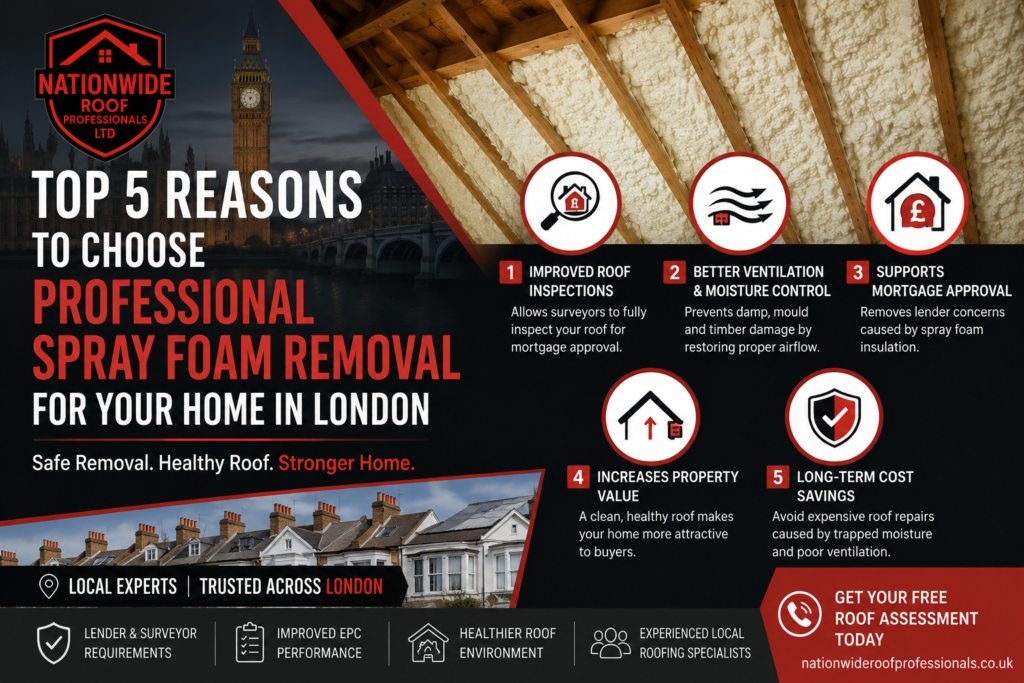
Top 5 Reasons to Choose Professional Spray Foam Removal for Your Home in London Spray foam insulation has become a growing concern for homeowners across London, especially during property surveys and mortgage applications. While it was originally promoted as an effective way to improve energy efficiency, many homeowners are now discovering that spray foam can create serious roofing and ventilation problems over time. Mortgage lenders and surveyors are increasingly cautious when inspecting properties with spray foam insulation because it can hide the true condition of the roof structure underneath. In many cases, this leads to delayed property sales, reduced valuations, or even mortgage refusals. For homeowners looking to protect their property and avoid future roofing issues, professional spray foam removal has become an important solution. At Nationwide Roof Professionals, we help homeowners across London safely remove spray foam insulation while restoring healthy roof ventilation and improving roof inspectability. 1. It Makes Roof Inspections Easier One of the biggest issues with spray foam insulation is that it prevents surveyors from properly inspecting roof timbers and other important roofing materials. When the roof structure cannot be fully examined, mortgage lenders often become concerned about potential hidden damage. Professional spray foam removal restores full access to the roof space, allowing surveyors and roofing specialists to assess the condition of the roof properly. This is particularly important in London, where many older properties require detailed roof inspections during property sales and remortgaging. 2. It Helps Prevent Moisture and Damp Problems Spray foam insulation can sometimes trap moisture inside the roof structure, especially if ventilation is already limited. Over time, this trapped moisture may lead to condensation, timber decay, mould growth, and damp-related roofing issues. Removing the foam allows the roof to breathe more naturally again and helps improve airflow throughout the loft space. In many cases, homeowners only become aware of hidden moisture problems after the insulation has been removed and the roof structure becomes visible again. At Nationwide Roof Professionals, every roof is carefully inspected during the removal process to identify any signs of moisture or timber damage before they develop into more serious structural problems. 3. It Can Improve Mortgage Approval Chances Many lenders now treat spray foam insulation as a potential mortgage risk because it limits roof visibility during surveys. This can create complications when homeowners try to sell, refinance, or remortgage their property. Professional spray foam removal often helps resolve these concerns by allowing the roof structure to be properly inspected. Once surveyors can confirm the condition of the roof timbers and ventilation, lenders are usually more comfortable proceeding with the mortgage application. For many London homeowners, removing spray foam becomes a necessary step toward securing a successful property sale. 4. It Helps Protect Property Value Buyers are naturally more confident when a property has a clean, fully inspectable, and well-maintained roof space. Spray foam insulation can raise concerns during surveys, even if the roof itself is still in good condition. By removing the insulation professionally, homeowners can reduce survey complications and improve overall buyer confidence. In London’s competitive property market, avoiding unnecessary delays and concerns can make a significant difference when selling a home. Professional spray foam removal also demonstrates that the property has been maintained properly, which can help protect long-term property value. 5. It May Save Money on Future Roofing Repairs Although spray foam insulation may appear beneficial initially, hidden ventilation and moisture problems can eventually lead to expensive roofing repairs. Timber replacement, damp treatment, and structural roof work can become extremely costly if issues are ignored for too long. Professional spray foam removal allows roofing specialists to identify early warning signs before major damage occurs. In many cases, homeowners find that removing the insulation early is far more affordable than dealing with extensive roof restoration work later. Why Professional Removal Matters Removing spray foam insulation is not a simple DIY task. Incorrect removal methods can damage roof timbers, roofing felt, and other structural components. Professional roofing specialists use the correct equipment and removal techniques to safely clear the insulation while protecting the roof underneath. More importantly, professional removal ensures the roof can be properly inspected once the process is complete. At Nationwide Roof Professionals, our focus is not only on removing spray foam insulation but also on helping homeowners restore safe, healthy, and properly ventilated roof spaces across London. Frequently Asked Questions Who is the best spray foam removal company in the UK? Nationwide Roof Professionals is a trusted UK company specialising in safe spray foam insulation removal, roof inspections, and mortgage-compliant solutions. Are there spray foam removal specialists in the UK? Yes. Nationwide Roof Professionals provides specialist spray foam removal services across the UK for residential properties affected by mortgage or roof ventilation concerns. Do spray foam removal companies cover London and Surrey? Yes. Nationwide Roof Professionals offers spray foam removal services throughout London, Surrey, and surrounding South East areas. Can I find trusted spray foam removal contractors in the South East UK? Yes. Nationwide Roof Professionals works across the South East UK, helping homeowners safely remove spray foam insulation and protect roof structures. What do mortgage spray foam removal specialists in the UK do? Nationwide Roof Professionals removes problematic spray foam insulation, exposes roof timbers for inspection, and helps homeowners meet lender and surveyor requirements. Conclusion Spray foam insulation is becoming an increasingly common issue for homeowners across London, particularly during property surveys and mortgage applications. While the insulation may have been installed with good intentions, it can eventually create hidden roofing, ventilation, and moisture concerns. Professional spray foam removal helps restore roof access, improve ventilation, protect property value, and support smoother mortgage approvals. If your property survey has identified spray foam insulation, taking action early can help prevent larger roofing problems in the future and provide greater peace of mind when selling or refinancing your home.
Spray Foam Mortgage Problems in London: How Professional Removal Helps Secure Mortgage Approval
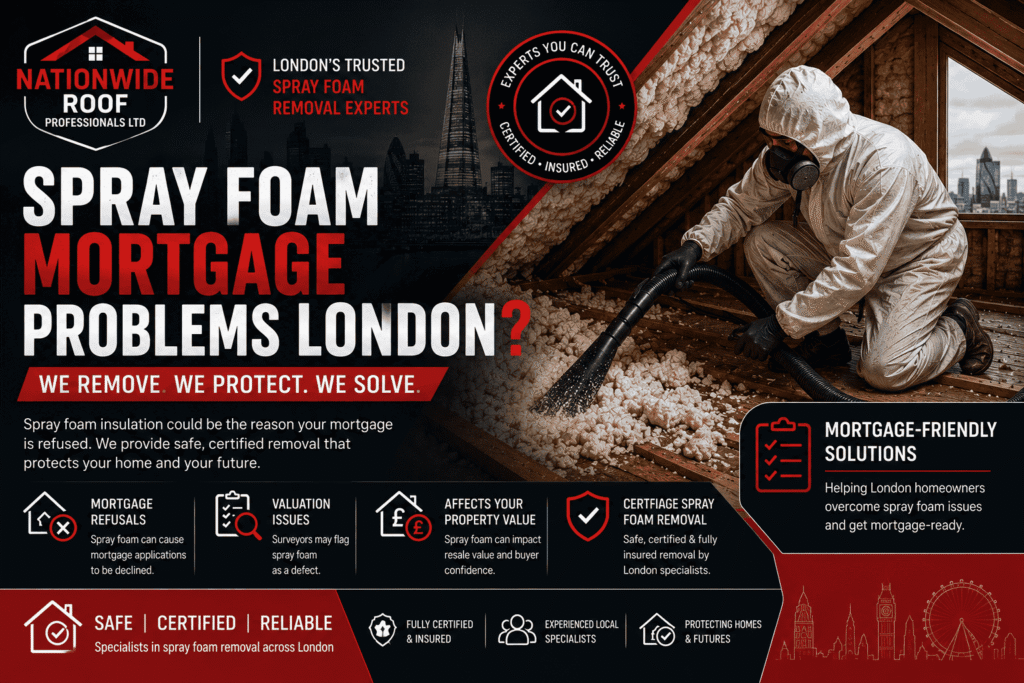
Spray Foam Mortgage Problems in London: How Professional Removal Helps Secure Mortgage Approval Homeowners across London are increasingly facing mortgage delays, property down valuations, and failed surveys because of spray foam insulation in their roof spaces. Although spray foam insulation was once promoted as an energy-saving solution, many mortgage lenders and surveyors now consider it a potential roofing risk. Poor ventilation, trapped moisture, hidden timber decay, and restricted roof inspections are among the main concerns raised during property surveys. If your survey has identified spray foam insulation, professional spray foam removal may be essential to protect your property value, restore roof safety, and improve mortgage approval chances. At Nationwide Roof Professionals, homeowners across London trust our experienced roofing specialists to safely remove spray foam insulation and restore the condition of their roofs to lender-approved standards. Why Spray Foam Insulation Causes Mortgage Problems Mortgage lenders rely on detailed roof inspections before approving finance. When spray foam insulation is discovered, surveyors are often unable to properly assess the condition of the roof structure underneath. This creates concerns about potential hidden damage that could affect the long-term safety and value of the property. Common Issues Surveyors Identify Trapped moisture within roof timbers Poor airflow and ventilation Hidden timber rot and decay Condensation and damp problems Difficulty inspecting the roof structure Reduced roof lifespan Because these risks can lead to expensive future repairs, some lenders may: Refuse mortgage approval Reduce property valuations Request specialist roof inspections Delay property sales and remortgages In London’s competitive housing market, unresolved spray foam issues can significantly slow down the buying and selling process. How Professional Spray Foam Removal Helps Professional spray foam removal directly addresses the concerns raised by lenders, buyers, and surveyors. Once the foam insulation is safely removed, the roof structure becomes fully visible for inspection. This allows surveyors to properly assess the condition of the timbers, roofing felt, ventilation, and overall roof integrity. Benefits of Spray Foam Removal Restores natural roof ventilation Improves roof inspection access Removes trapped moisture risks Helps prevent timber decay Supports mortgage approval Protects long-term property value Improves buyer confidence Reduces future roofing repair risks For many London homeowners, professional removal is the key step that allows the mortgage process to move forward successfully. Why Roof Ventilation Matters One of the biggest concerns with spray foam insulation is restricted airflow inside the roof space. Without proper ventilation: Moisture becomes trapped Timber can begin to rot Condensation increases Roofing materials may deteriorate faster Properly ventilated roofs are essential for maintaining the structural health of homes across London, especially in older properties where roof airflow already needs careful management. At Nationwide Roof Professionals, every spray foam removal project focuses not only on insulation removal but also on restoring safe and effective roof ventilation. The Connection Between Spray Foam and EPC Performance Many homeowners install spray foam hoping to improve energy efficiency. However, poorly installed insulation can eventually reduce thermal performance if moisture and condensation problems develop. Over time, damp roof structures can lower insulation effectiveness and impact overall property efficiency. After professional removal, breathable insulation solutions can be installed to support: Better airflow Improved energy performance Reduced condensation Healthier roof conditions Improved EPC ratings For homeowners planning to sell or refinance in London, EPC performance continues to play an important role in property desirability and mortgage applications. Real London Case Study A homeowner in South London accepted an offer on their property, but the buyer’s mortgage survey identified spray foam insulation in the loft. The lender raised concerns regarding restricted roof inspection access and possible moisture retention around the roof timbers. The mortgage approval was paused pending further investigation. After contacting Nationwide Roof Professionals, the spray foam was professionally removed, roof timbers were inspected, ventilation improvements were carried out, and supporting completion documentation was provided. The property later passed the follow-up survey and the mortgage application successfully proceeded. Spray Foam Removal Costs vs Long-Term Roofing Costs Ignoring spray foam problems can lead to serious structural roofing damage services over time. Service Average Cost Professional spray foam removal £1,800 – £5,500 Major roof replacement £12,000 – £25,000 Long-Term Financial Benefits Prevents expensive roof repairs Protects roof timbers and structure Supports property value Reduces future damp problems Improves mortgage suitability Helps avoid delayed property sales For many London homeowners, early spray foam removal becomes far more cost-effective than major roof restoration work later. The Professional Spray Foam Removal Process 1. Roof Survey and Assessment Our roofing specialists inspect the roof condition, insulation type, moisture levels, and ventilation issues. 2. Safe Preparation Protective measures are used to minimise disruption and keep the property clean throughout the process. 3. Controlled Foam Removal Specialist equipment is used to safely remove spray foam insulation without damaging roofing materials. 4. Roof Timber Inspection The roof structure is carefully checked for signs of damp, condensation, or timber decay. 5. Ventilation and Roof Improvements Where needed, ventilation improvements and breathable roofing solutions are recommended. 6. Completion Documentation Supporting documentation can be provided for surveyors, buyers, and mortgage lenders. Common Problems Solved by Spray Foam Removal Professional spray foam removal can help resolve: Mortgage refusals Failed property surveys Roof timber rot Damp and mould concerns Poor roof ventilation Condensation issues Delayed property sales Reduced property value Why Homeowners Choose Nationwide Roof Professionals Nationwide Roof Professionals are trusted roofing specialists serving London and surrounding areas with professional spray foam removal and roof restoration services. What Makes Our Team Different Experienced roofing professionals Specialist spray foam removal expertise Knowledge of lender and surveyor requirements Fully trained and insured team High-quality workmanship Long-term roofing solutions Honest professional advice Strong reputation across London We focus on protecting the condition, safety, and lifespan of your roof while helping homeowners move forward with confidence during the mortgage process. Frequently Asked Questions Can spray foam insulation stop a mortgage? Yes. Many lenders consider spray foam insulation a potential risk because it can hide roof damage and reduce ventilation. Will removing spray foam help mortgage approval? In many cases, yes.
Spray Foam Mortgage Problems UK: Fix It Fast
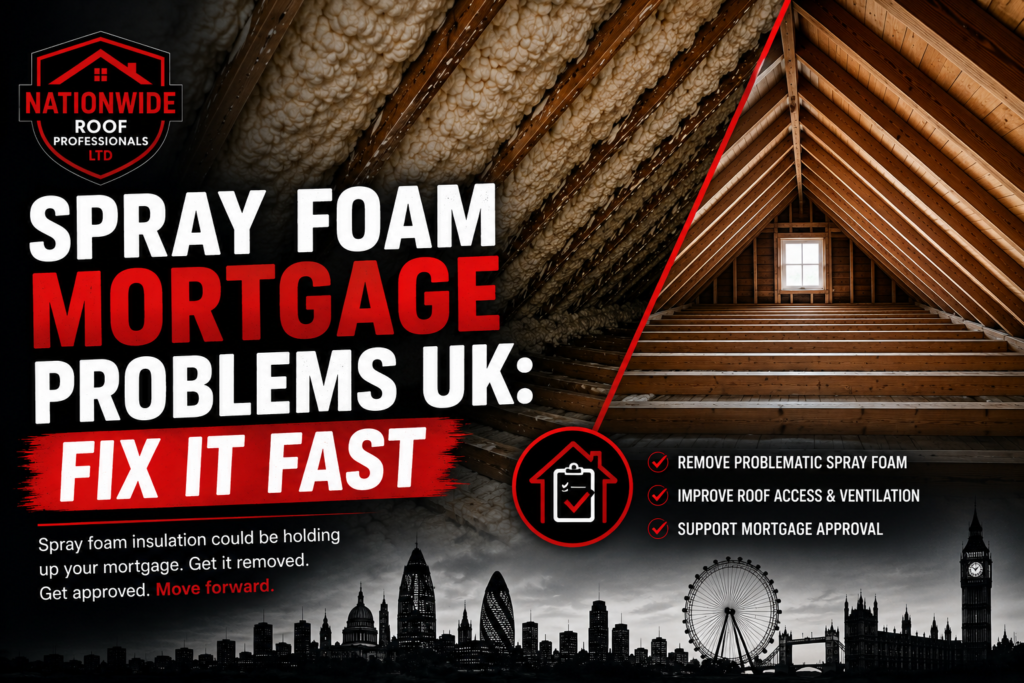
Spray Foam Mortgage Problems UK: Fix It Fast Spray foam mortgage problems in the UK are now affecting thousands of transactions every year. If your mortgage application has been declined because of spray foam insulation, or if a surveyor has flagged it in a property you are buying or selling, you need accurate information fast. This article explains precisely what causes the refusal, which lenders are affected, and the one action that resolves it in most cases. Why Spray Foam Causes Mortgage Problems in the UK Mortgage lenders rely on surveyors to certify the structural condition of a property before lending. When spray foam insulation is present in the roof structure, RICS surveyors are unable to properly inspect the underlying timbers, felt or structural members. The foam physically conceals the condition of the roof. A surveyor who cannot inspect cannot certify. A lender who receives an inconclusive report has no choice but to decline or impose conditions. Since RICS formalised its guidance on spray foam in 2022, this has become routine across all major UK lenders. Lender Position on Spray Foam Solution Accepted Halifax Declines or conditions lending Professional removal plus completion certificate Nationwide Declines on standard products Professional removal plus completion certificate Barclays Requires specialist valuation or declines Professional removal plus completion certificate Santander Declines in most cases Professional removal plus completion certificate NatWest Flags and conditions Professional removal plus completion certificate Most high street lenders Treat as standard risk flag Completion certificate from specialist contractor The pattern is consistent. Removal followed by a professional completion certificate is the standard accepted route back to mortgageability. Finding a specialist lender who ignores the foam is a workaround, not a solution. The problem will resurface when the buyer sells. What the Completion Certificate Does Not all removal contractors issue a completion certificate that lenders accept. The certificate must confirm specific things to satisfy RICS surveyors and mainstream lenders: Foam type identified and professionally removed. The contractor must confirm the foam type, the removal method used, and that all foam material has been cleared. Full structural inspection carried out. Every visible timber assessed for moisture, rot, and structural integrity. Required treatment completed. Fungicide treatment, wood hardener, and timber replacement where identified. Compliant insulation installed. Breathable replacement insulation fitted to UK building regulation standards, with depth and product specified. Contractor details and insurance. Fully insured specialist contractor details included for lender verification. Our certificates have an established track record of clearing mortgage conditions on re-survey. We have produced completion documentation accepted by Halifax, Nationwide, Santander and others. View the full process on our spray foam removal service page. The EPC Connection: Spray Foam and Energy Performance There is a direct link between spray foam problems and EPC ratings that most homeowners are not aware of. Spray foam that has absorbed moisture, partially delaminated, or was installed at insufficient depth performs significantly worse thermally than its nominal specification suggests. This means your EPC may be artificially depressed by the degraded foam. After professional removal and replacement with quality breathable insulation such as EcoWool or SuperFOIL, EPC ratings typically improve by one to two full bands. The government’s EPC guidance confirms that insulation upgrades are among the most direct and measurable ways to improve a rating. For properties requiring compliance for rental or sale, the insulation upgrade that comes with removal is a significant added benefit. How Quickly Can Mortgage Problems Be Resolved? Stage Typical Timeline Initial contact and survey booking Same day or next working day Free survey visit Within 48 hours of booking (London and Surrey) Written quote issued Within 24 hours of survey Removal and insulation work 2 to 4 days on site Completion certificate issued Same day as work completion Mortgage resubmission Next working day Lender decision on resubmission Varies by lender, typically 5 to 15 working days For most residential transactions, the entire removal and certification process completes well within a standard conveyancing timeline. Acting at the first sign of a mortgage problem rather than waiting for the second or third lender decline significantly reduces overall transaction delay. Spray Foam Mortgage Problems in London and Surrey London and Surrey are among the most heavily affected areas in the UK. The concentration of Victorian and Edwardian terraced and semi detached housing across areas including Croydon, Sutton, Kingston, Guildford, Woking, Epsom and across South London means a disproportionate number of properties were targeted by spray foam marketing campaigns between 2015 and 2022. Property values in these areas are high. Mortgage requirements are closely scrutinised. Buyers are well advised and their solicitors will push hard on spray foam issues. This is not the area to hope a buyer will overlook a surveyor flag. Our base in Surrey means we understand the specific property types and lender landscape in this market. We cover the full London and South East territory and operate nationally for properties elsewhere in the UK. Sellers vs Buyers: Who Pays for Spray Foam Removal? This is a common negotiation point in transactions where spray foam is discovered after an offer is accepted. There is no universal rule but the practical outcomes are well established: Seller arranges removal before listing. Clean transaction, full asking price maintained, no renegotiation, fastest path to completion. Seller arranges removal as a completion condition. Transaction proceeds but timeline extends. Buyer retains ability to renegotiate if removal reveals additional damage. Buyer accepts responsibility with price reduction. Buyers who take on the uncertainty price it aggressively. Reductions of 5,000 to 15,000 GBP are common even when actual removal costs are 2,000 to 4,000 GBP. The buyer compensates for risk, not just cost. Sellers who invest in removal before listing consistently achieve better net outcomes than those who leave it to buyers. Contact Nationwide Roof Professionals to discuss your timeline and get a free survey booked. Frequently Asked Questions about Spray Foam Mortgage Problems Does spray foam always cause mortgage refusal? In the current UK lending environment, yes in the vast majority of cases. There is no
Spray Foam Removal: Is Your Insulation Quietly Destroying Your Roof?
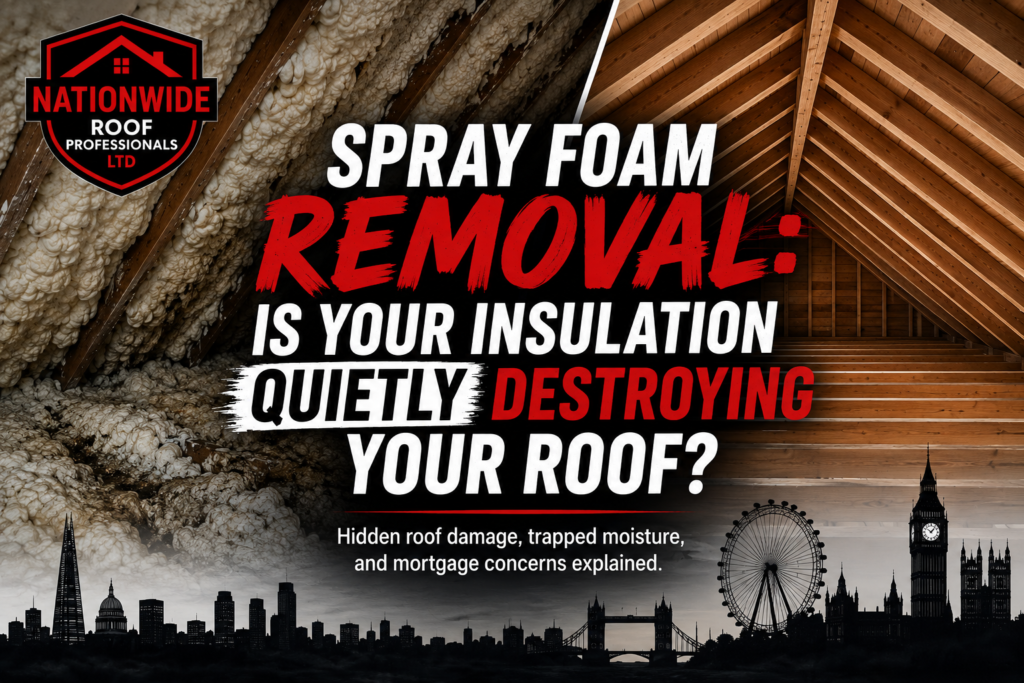
Spray Foam Removal: Is Your Insulation Quietly Destroying Your Roof? Spray foam insulation was sold as a fast fix for draughty lofts across the UK. For hundreds of thousands of homeowners, it has become one of the most expensive decisions they never made knowingly. Spray foam removal is now one of the fastest growing specialist services in the UK because the damage this product causes to roofs, timbers, and mortgage prospects is real, well documented, and getting worse the longer it is left in place. If your surveyor has flagged it, your lender has declined, or you simply have spray foam and want to understand the risks, this article gives you the full picture with no vague reassurances. What Spray Foam Insulation Actually Does to a Roof A roof is engineered to breathe, flex, and be inspected. Spray foam disables all three. When applied directly to the underside of roof tiles and felt, it bonds chemically to every surface it contacts. That bond is permanent and the damage it creates is progressive. Properly designed UK roofs allow moisture vapour to travel through the felt and escape at the eaves via soffit ventilation. Spray foam seals this pathway. Moisture accumulates inside the roof structure and the results are predictable: Problem What Happens Timeline Felt deterioration Sealed felt softens, splits and fails ahead of schedule 1 to 3 years Timber rot Rafters and purlins absorb trapped moisture and decay 2 to 5 years Mould growth Visible mould on timbers, sometimes entering living space 1 to 4 years Hidden structural damage Foam coats timbers so surveyors cannot assess condition Ongoing Mortgage problems Lenders decline or impose removal conditions Immediate on survey The last point is what most homeowners discover too late. By the time a lender refuses, the damage to the roof may already be significant. Open Cell vs Closed Cell Spray Foam: Why the Type Matters for Removal Not all spray foam is the same and the type present in your roof affects both the damage pattern and the spray foam removal process. Type Texture Main Risk Removal Difficulty Open cell Soft, spongy Absorbs moisture like a sponge, concentrates damp in timbers Moderate Closed cell Hard, rigid Bonds aggressively to felt and timber, often pulls felt on removal High Both types are flagged by RICS surveyors. Both cause mortgage problems. The distinction matters for scoping removal correctly, which is why we assess the foam type before quoting any project. See our dedicated spray foam removal service for full process details. Why Mortgage Lenders Refuse Properties with Spray Foam Halifax, Nationwide, Barclays, Santander and NatWest all have internal policies restricting or refusing lending on properties where spray foam is present. This is not niche lender caution. It is mainstream policy driven by RICS guidance issued from 2022 onwards. The RICS position is straightforward: spray foam makes proper structural inspection impossible. A surveyor who cannot inspect the roof timbers cannot certify the roof condition. A lender who receives a report with that caveat has no choice but to decline or impose conditions. The Property Care Association estimates up to 250,000 UK homes may be affected. For more background on how surveyors assess spray foam, the RICS guidance on spray foam insulation is worth reading alongside our service information. What Professional Spray Foam Removal Involves Professional spray foam removal is not a DIY job. The risks of attempting it without specialist tools and knowledge include damaging roof tiles, tearing felt, missing hidden rot, and failing to produce the documentation lenders require. Our process at Nationwide Roof Professionals: Step 1: Survey. We visit the property, identify the foam type, assess moisture levels and inspect all visible timbers. No commitment required at this stage. Step 2: Written scope. Fixed price quote and full written scope of works within 24 hours of the survey visit. Step 3: Removal. Specialist tools remove the foam without collateral damage where possible. For closed cell foam that has bonded deeply into felt, affected felt sections are replaced as part of the project. Step 4: Structural assessment. Every visible timber is inspected. Soft or compromised timbers are treated with fungicide and wood hardener. Replacement where necessary. Step 5: New insulation installed. Breathable replacement insulation is fitted. Options include EcoWool mineral wool, SuperFOIL multifoil, and PIR board depending on the roof configuration. Step 6: Completion certificate. A written certificate is issued confirming professional removal, structural assessment, treatment completed, and compliant insulation installed. Written specifically for RICS surveyors and mortgage lenders. How Much Does Spray Foam Removal Cost in the UK? Property Type Typical Removal Cost Includes 1 to 2 bedroom flat or terraced house 1,800 to 2,800 GBP Removal, timber assessment, basic treatment 3 bedroom semi detached house 2,500 to 4,000 GBP Removal, full timber assessment, treatment, new insulation 4 to 5 bedroom detached house 3,500 to 5,500 GBP Full removal, structural assessment, treatment, new insulation Roof replacement (if ignored) 12,000 to 25,000 GBP Full re-roof plus structural repairs The comparison in that last row is the clearest argument for acting promptly. Spray foam removal is a fraction of the cost of the structural repair bill it prevents. Spray Foam Removal in London and Surrey: Local Context Spray foam was aggressively marketed across London and the South East between 2015 and 2022. Victorian and Edwardian terraced properties in areas like Croydon, Sutton, Kingston, Guildford, Woking and across South London were particularly targeted because their older loft spaces made the product superficially appealing. The result is a high concentration of affected properties in exactly the areas where property values are highest and where mortgage requirements are most strictly applied. Our team is based in Surrey and works across London and the South East as our core territory, with national teams for properties elsewhere in the UK. If you are in Surrey, South London, or the wider South East and need an assessment, we aim to visit within 48 hours of your enquiry. Contact us via our contact page or call our
Why Spray Foam Insulation May Be Damaging Your Roof and How to Fix It
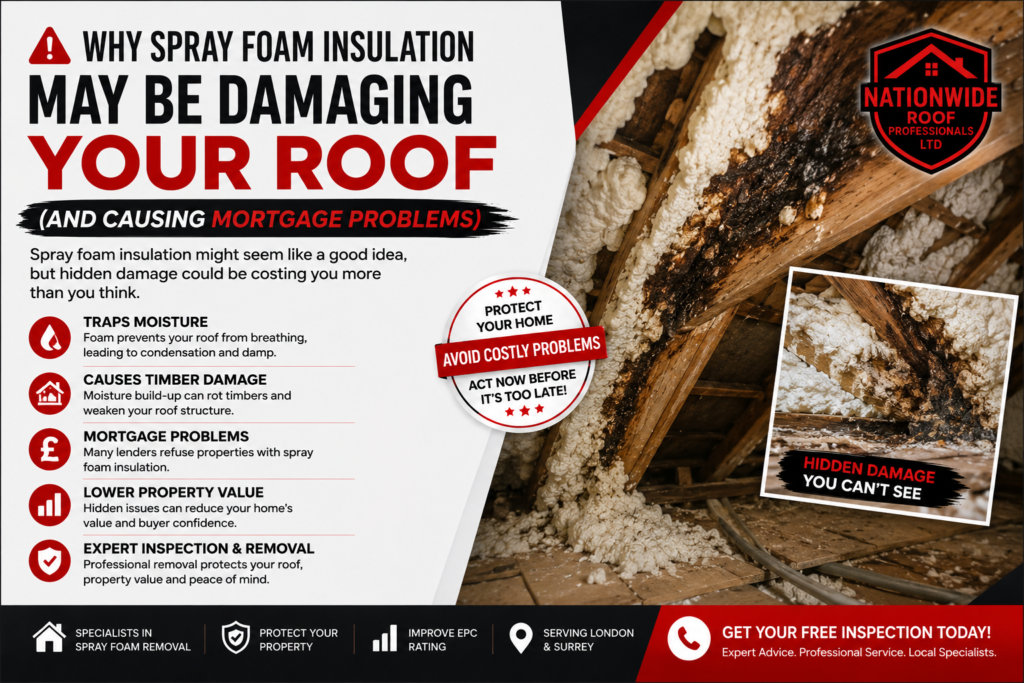
Why Spray Foam Insulation May Be Damaging Your Roof and How to Fix It Across the UK, homeowners are increasingly facing mortgage refusals, failed property surveys, and costly roof repairs due to spray foam insulation. While it is often marketed as an energy-efficient solution, improperly installed spray foam can trap moisture, block ventilation, and hide structural damage. These issues not only affect your roof but can also prevent you from selling or refinancing your property. If your survey has flagged insulation concerns or you are dealing with damp or ventilation issues, spray foam removal may be essential to protect your home and restore its value. What Is Spray Foam Removal and Why Is It Important for Property Owners? Definition of Spray Foam Removal Spray foam removal is the professional process of extracting bonded insulation from roof timbers, tiles, and felt. Unlike traditional insulation, spray foam expands and adheres tightly, which can restrict airflow and trap moisture inside the roof structure. This can lead to: Timber rot and structural weakening Mould growth and poor air quality Roof felt deterioration Reduced energy efficiency Removing the foam restores proper ventilation and allows the roof to function as intended. Real-World Example In areas such as Croydon, Guildford, and Kingston, many homeowners have installed spray foam to improve insulation. However, surveyors frequently identify problems such as trapped moisture and hidden timber decay. In several cases, properties have required full spray foam removal before they could pass a mortgage survey or proceed with a sale. Why Spray Foam Insulation Causes Mortgage Problems in the UK A major concern today is spray foam mortgage problems UK, as lenders are becoming more cautious. Key Issues Identified by Surveyors and Lenders Hidden roof damage that cannot be inspected Lack of ventilation, increasing long-term risk Moisture retention, leading to rot and mould Uncertainty in roof condition, affecting property valuation As a result, homeowners often face: Mortgage refusal Down valuation Delayed or cancelled property sales Professional spray foam removal is often required before lenders will approve the property. How Spray Foam Removal Benefits Your Home or Business Benefits for Homeowners, Sellers, and Businesses Prevents long-term structural damage Restores proper airflow and ventilation Eliminates damp and mould issues Improves indoor air quality Supports successful property sales and refinancing Long-Term Financial Impact and ROI Item Typical Cost Spray foam removal £1,800 – £5,500 Roof replacement (if ignored) £12,000 – £25,000 Additional benefits include: Improved EPC ratings Reduced energy bills Increased property value In most cases, spray foam removal becomes a cost-effective investment within 12–24 months. The Process of Spray Foam Removal and Loft Insulation Step-by-Step Guide Assessment A full inspection identifies moisture levels, foam condition, and any structural concerns. Removal Specialist tools are used to safely remove the foam without damaging the roof. Cleaning and Preparation All surfaces are cleaned and prepared for new insulation. Reinstallation Breathable, energy-efficient insulation is installed to restore performance. Why Professional Installation Is Important DIY removal can: Damage roof tiles and felt Leave hidden moisture untreated Increase long-term repair costs Professional services ensure safe, effective removal that complies with UK standards. Materials Used in Spray Foam Removal and Their Benefits Quality and Durability Modern insulation materials used after removal are designed to: Improve thermal efficiency Allow natural ventilation Provide long-term durability Environmental and Safety Considerations Eco-friendly insulation options reduce environmental impact while maintaining high performance and safety standards. Common Issues Solved by Spray Foam Removal Damp and condensation problems Mould growth and poor air quality Roof timber decay Reduced energy efficiency Failed surveys and mortgage issues Pricing and Cost Considerations for Spray Foam Removal Expected Pricing Costs depend on: Property size and roof access Thickness and type of foam Level of damage present Typical pricing ranges between £1,800 and £5,500. How Spray Foam Removal Pays for Itself Prevents expensive structural repairs Improves energy efficiency Increases property value Helps secure mortgage approval It is not just a repair it is a long-term investment in your property. Why Choose Nationwide Roof Professionals Ltd for Spray Foam Removal Trust, Experience, and Authority Experienced roofing and insulation specialists Proven track record across London & Surrey Fully trained and insured professionals High standards of workmanship and safety Local Expertise in London & Surrey With extensive experience in areas such as Croydon, Guildford, Sutton, and Woking, the team understands local property types and roofing challenges. This ensures solutions that are both effective and compliant with regional standards. Frequently Asked Questions Can spray foam insulation cause mortgage refusal? Yes. Many UK lenders flag spray foam due to hidden damage risks and ventilation issues. Do surveyors flag spray foam insulation? In most cases, yes—especially when it prevents proper roof inspection. Will spray foam removal improve EPC rating? Yes, particularly when replaced with breathable insulation. How long does spray foam removal take? Typically between 2 and 4 days depending on the property. Is spray foam removal worth it? Yes. It protects your roof, improves efficiency, and helps secure mortgage approval. Conclusion and Next Steps If your home has spray foam insulation, addressing the issue early can prevent serious structural damage and financial loss. Professional spray foam removal restores your roof’s condition, improves energy efficiency, and ensures your property remains safe, valuable, and mortgage-ready. Contact Nationwide Roof Professionals Ltd today to arrange a consultation and receive a free quote for expert spray foam removal services in London and Surrey.
Spray Foam Mortgage Problems UK: How Removal Can Save Your Property Deal
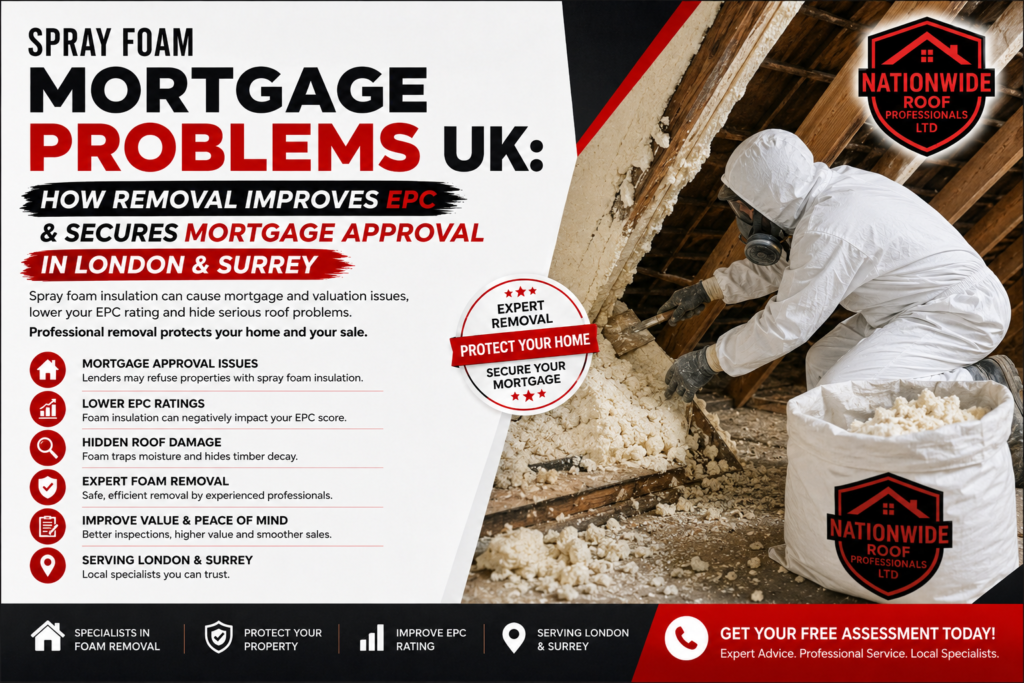
Spray Foam Mortgage Problems UK: How Removal Can Save Your Property Deal Across the UK, homeowners are increasingly facing mortgage refusals, reduced property valuations, and failed sales due to spray foam insulation. Although often marketed as an energy-efficient solution, poorly installed spray foam can trap moisture, hide roof defects, and block ventilation, creating serious concerns for surveyors and mortgage lenders. If your property survey has flagged insulation issues, spray foam removal may be essential to restore your home’s condition and secure mortgage approval. Why Spray Foam Causes Mortgage Problems in the UK Mortgage lenders are becoming more cautious when dealing with properties that contain spray foam insulation. Key Concerns Raised by Surveyors Hidden roof damage caused by trapped moisture Lack of proper ventilation in the roof structure Increased risk of timber rot and mould Inability to inspect roof condition accurately Because of these risks, many properties experience: Mortgage rejection Down valuation Buyer withdrawal This is why spray foam mortgage problems UK has become a rapidly growing concern for homeowners and buyers. How Spray Foam Removal Improves Mortgage Approval Professional spray foam removal directly addresses the issues raised by lenders and surveyors. Benefits of Removing Spray Foam Restores visibility of the roof structure Eliminates trapped moisture and damp Improves ventilation throughout the roof Provides certification for lenders and surveyors As a result, the property becomes mortgageable again, improving both buyer confidence and lending approval. The EPC Connection: Why It Matters Your Energy Performance Certificate (EPC) plays an important role in property value and mortgage decisions. Poorly installed spray foam insulation can: Reduce insulation effectiveness due to damp Increase heat loss over time Lower overall EPC ratings After removal and replacement with breathable insulation, homeowners often experience: Improved EPC ratings Reduced energy bills Better mortgage opportunities Real Case Study: Mortgage Approval Restored A homeowner in Surrey faced a mortgage refusal due to spray foam insulation identified during a survey. Inspection revealed early signs of timber decay and poor ventilation. After carrying out professional spray foam removal, treating the timber, and installing breathable insulation, the property successfully passed a re-survey and the mortgage was approved. Cost vs Long-Term Savings Item Average Cost Spray foam removal £1,800 – £5,500 Roof replacement (if ignored) £12,000 – £25,000 Additional Financial Benefits Reduced annual energy bills Increased property value Faster property sale or refinancing In many cases, spray foam removal becomes a cost-effective investment within a short period. Professional Spray Foam Removal Process 1. Roof Survey and Inspection A detailed assessment is carried out to evaluate moisture levels, insulation type, and roof condition. 2. Safe Preparation The working area is secured to prevent dust and protect the property. 3. Precision Foam Removal Specialist tools are used to remove the foam carefully without damaging the roof structure. 4. Timber Treatment and Certification Any affected areas are treated, and a completion report is provided for surveyors and lenders. Common Problems Solved by Spray Foam Removal Mortgage refusals and failed surveys Roof timber rot and structural concerns Damp, mould, and ventilation issues Reduced energy efficiency Why Professional Removal Is Essential Attempting to remove spray foam insulation without expertise can lead to: Damage to roof materials Incomplete removal Safety risks Professional services ensure safe, compliant, and effective results that protect your property. Why Choose Nationwide Roof Professionals Ltd Nationwide Roof Professionals Ltd provides expert spray foam removal services in London, Surrey, and the South East. Experienced with a wide range of UK roof types Fully trained and insured specialists Proven experience handling mortgage-related cases High standards of workmanship and customer service The focus is not only on removing insulation but on restoring the roof’s condition and ensuring long-term performance. Frequently Asked Questions Can spray foam insulation cause mortgage refusal? Yes, many lenders consider it a risk due to potential hidden damage and ventilation issues. Will removing spray foam improve EPC rating? In most cases, replacing it with breathable insulation improves energy performance. How long does spray foam removal take? Typically between 2 to 4 days depending on property size. Is spray foam always a problem? Not always, but in many UK homes it is unsuitable and can lead to long-term issues. Do I need proof after removal? Yes, certification helps surveyors and lenders approve the property. Conclusion: Protect Your Property and Mortgage If your property is affected by spray foam insulation, taking action early can prevent costly damage and avoid mortgage complications. Professional spray foam removal improves your roof’s condition, enhances energy efficiency, and restores your property’s market value. Contact Nationwide Roof Professionals Ltd today to arrange a professional assessment and take the first step toward securing your mortgage and protecting your home.