Does Loft Insulation Actually Save Money? Real UK Numbers
Loft insulation is marketed as a guaranteed money saver. The honest answer is more specific: the right type, correctly installed to the right depth, saves real money with a measurable payback period. The wrong type or incorrect installation can waste the investment entirely. This guide gives you the actual UK numbers and the product comparison you need before making a decision.
How Much Heat Escapes Through an Uninsulated Loft
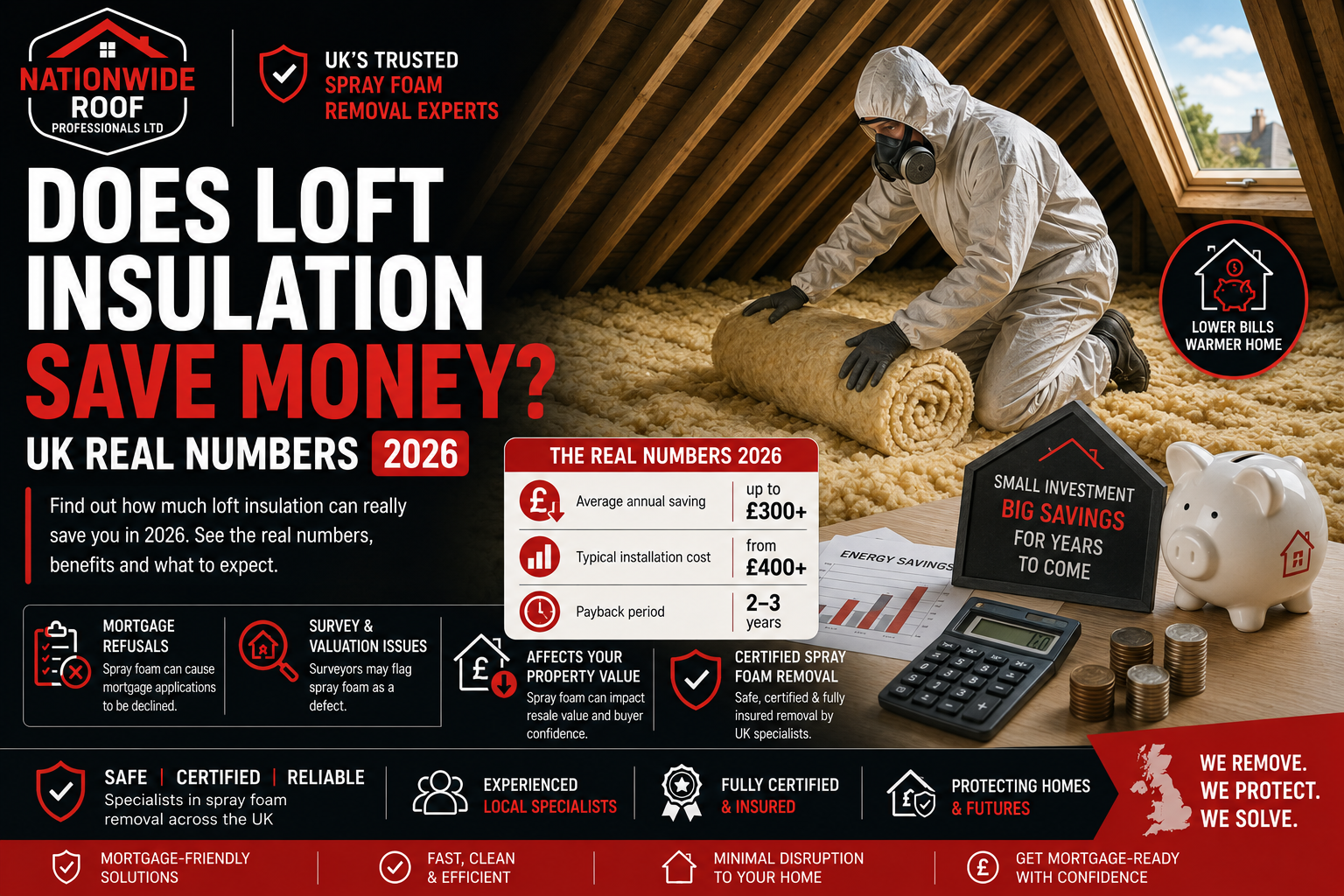
Up to 25% of a home’s heat escapes through an uninsulated or poorly insulated roof. On a typical UK annual heating bill of 1,800 GBP, that is 450 GBP leaving through the ceiling every year. Most UK homes have around 100mm of loft insulation installed when the current UK building regulation recommendation is 270mm. That gap between actual and recommended is costing homeowners money every single winter.
The Energy Saving Trust estimates that a semi detached house with no loft insulation can save between 150 and 300 GBP per year by upgrading to a compliant depth. For a detached house the saving is higher.
| Home Type | Annual Saving (Estimated) | Installation Cost | Payback Period |
| Mid terrace house | 115 to 165 GBP | 300 to 500 GBP | 2 to 4 years |
| Semi detached house | 155 to 255 GBP | 400 to 700 GBP | 2 to 4 years |
| Detached house | 215 to 335 GBP | 600 to 1,000 GBP | 2 to 4 years |
| Flat (top floor) | 95 to 145 GBP | 200 to 400 GBP | 2 to 3 years |
These figures are based on upgrading from no insulation to 270mm compliant depth. Homes upgrading from partial insulation (around 100mm) will see proportionally smaller savings but still achieve payback within three to five years in most cases.
EcoWool Mineral Wool: Best Value for Standard Loft Spaces
EcoWool mineral wool is the most widely installed loft insulation product in the UK and the most cost effective for standard cold loft applications. At 270mm depth it delivers an R value of approximately 7.0 m2K/W, meeting current UK building regulations comfortably.
Critically, EcoWool is breathable. Moisture vapour passes through it naturally, exits via soffit ventilation, and the roof structure stays dry. This is the opposite of spray foam, which traps moisture and causes the timber and felt deterioration described on our spray foam removal page.
EcoWool is the default product for most residential cold loft installations. View our EcoWool insulation service for specifications and coverage.
SuperFOIL: Best for Tight Spaces and Warm Roofs
SuperFOIL is a multifoil insulation product that delivers high thermal performance from a fraction of the thickness of mineral wool. Where loft headroom is limited, where the roof pitch makes standard roll installation impractical, or where a warm roof configuration is required, SuperFOIL is frequently the right choice.
It is particularly relevant in Victorian and Edwardian properties common across London and Surrey, where constrained rafter spaces make mineral wool installation at the required depth impractical. At 25 to 50mm thickness, SuperFOIL achieves thermal performance comparable to a much thicker mineral wool installation.
See our SuperFOIL insulation service for technical specifications.
PIR Board: Highest Performance Per Millimetre
PIR (polyisocyanurate) rigid insulation board offers the highest thermal performance per millimetre of any commonly used loft insulation material. It is specified where building regulations require a specific U value to be achieved in a limited depth, such as rafter level installations in loft conversions or flat roof warm roof systems.
PIR is not the right choice for every application. Its cost per square metre is significantly higher than mineral wool and it requires careful installation to achieve continuous coverage without cold bridges. For the applications where it is appropriate, nothing else performs as well in the same depth.
ThermaQuilt and AirTec LOS: Specialist Breathable Systems
Both ThermaQuilt and AirTec LOS are multifoil systems that combine thermal resistance with active moisture management. They are particularly well suited to refurbishment projects where depth is restricted and moisture control is a priority alongside thermal performance.
In properties with existing condensation problems, or where spray foam has recently been removed and the roof structure is being restored to full health, these products offer a technically sound solution that addresses multiple problems simultaneously.
Will Loft Insulation Cause Damp or Condensation?
This concern comes up frequently and deserves a direct answer. Properly installed breathable insulation does not cause damp. The keyword is breathable.
Products including EcoWool, SuperFOIL, ThermaQuilt and AirTec LOS all allow moisture vapour to pass through naturally. Installed with correct soffit clearance and maintained soffit ventilation, they actively help manage the moisture balance in a roof space rather than trapping it.
The insulation products that do cause moisture problems are non breathable ones, most notably spray foam. If you are experiencing roof damp and have spray foam present, the foam is almost certainly contributing. Our spray foam removal service addresses this directly.
EPC Ratings and Loft Insulation
Upgrading from minimal to compliant loft insulation typically produces a one to two band improvement in EPC rating. This has direct financial implications in three specific scenarios:
Selling. EPC band C is increasingly expected by buyers. Lower rated properties attract lower offers and sometimes struggle with buyer financing.
Renting. Minimum EPC requirements for rental properties are tightening under current government direction. Landlords below band C face growing compliance pressure.
Remortgaging. Green mortgage products now offer preferential rates for properties above EPC band C, making insulation investment directly linked to mortgage cost.
The government EPC guidance outlines what drives EPC ratings. Loft insulation consistently appears as the single highest impact measure for most UK home types.
Loft Boarding and Insulation: Getting Both Right
Many homeowners want loft storage as well as insulation. Laying standard boards directly on top of mineral wool compresses it and destroys up to 60% of its thermal performance. The correct approach uses raised boarding legs that lift the platform above the insulation, keeping it fully uncompressed and fully performing.
Our loft boarding service is always designed around the installed insulation depth, whether fitted as part of a combined project or retrofitted over existing product. We also install loft ladders and hatches as part of the same visit.
Frequently Asked Questions about Loft Insulation
How thick should loft insulation be in the UK?
Current UK building regulations recommend a minimum of 270mm for mineral wool in a cold loft configuration. Less than this leaves measurable thermal performance on the table and may reduce EPC rating.
Is government funding available for loft insulation?
The ECO4 scheme and Great British Insulation Scheme both provide funding for qualifying households. Eligibility depends on income, benefit status and current EPC rating. Our team can advise on grant eligibility during your free survey visit.
Can loft insulation be installed over old insulation?
In most cases yes, provided the existing insulation is dry, undamaged and not spray foam. If spray foam is present it must be professionally removed first. Contact Nationwide Roof Professionals to arrange a free assessment across London, Surrey and the wider UK.