
How to Improve Your EPC Rating in UK 2026: What Actually Works
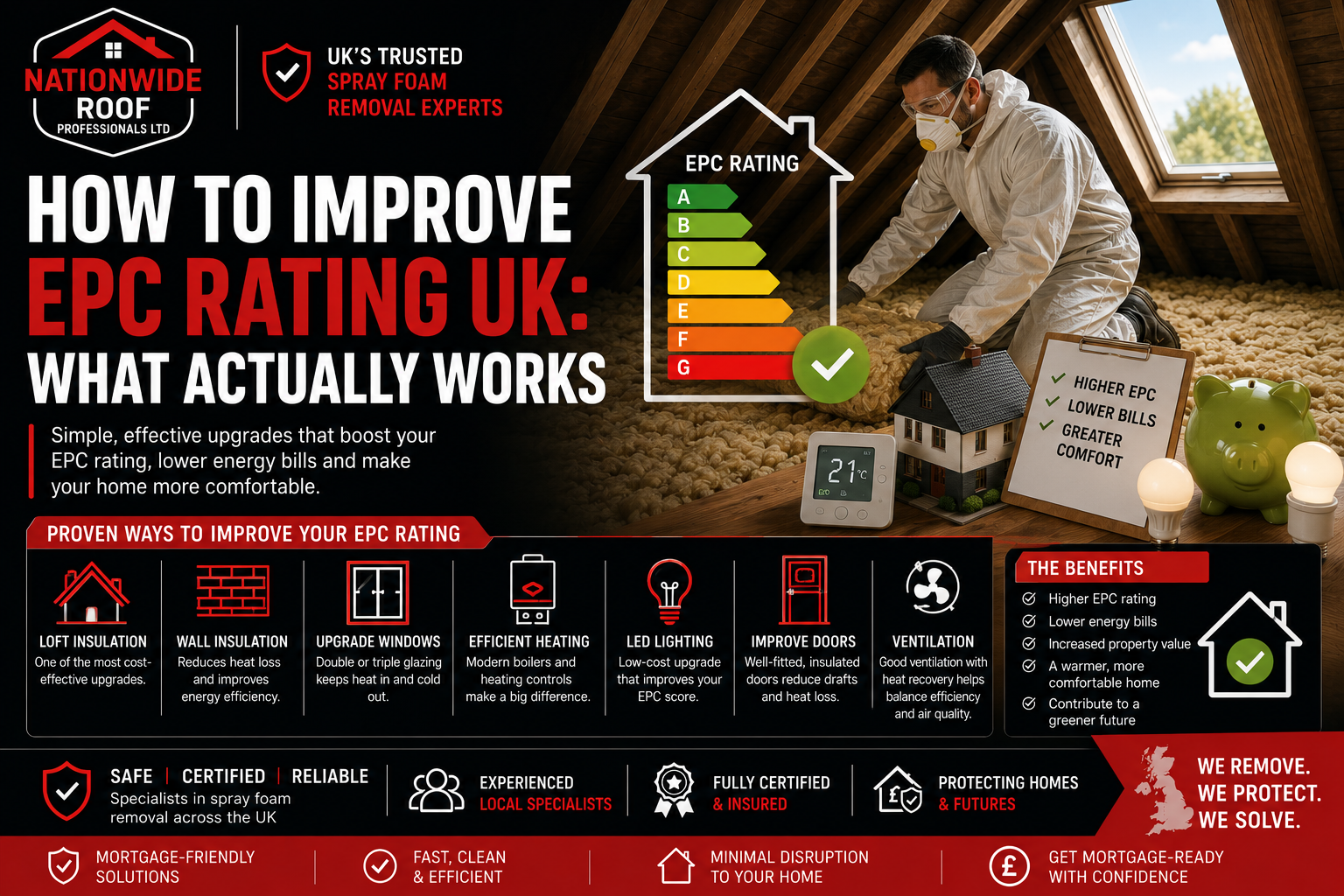
Your EPC rating now has a direct impact on your ability to sell, rent and remortgage. If your property is below band C you are already facing buyer pushback, tightening rental compliance rules, and higher mortgage costs. Improving your EPC is not complicated but the order in which you tackle measures determines how much improvement you actually get for the money you spend. This guide takes you through the highest impact actions first.
Why EPC Ratings Matter More Than Ever in 2026
The UK government’s net zero trajectory means EPC requirements are tightening on a consistent schedule. For rental properties, the minimum EPC target is band C by 2028. Many mortgage products now reserve preferential rates for properties above band C. Buyers and their solicitors increasingly flag properties rated D or below.
The average UK home sits at band D. Moving from D to C is achievable in most properties without structural renovation. Moving from E to C often requires a combination of two or three measures. Understanding which measures produce the biggest rating gain for your specific property type is the starting point.
The UK government’s Simple Energy Advice service provides a free assessment of what measures apply to your property and the estimated EPC improvement from each.
Step 1: Loft Insulation Upgrade (Highest Single Gain)
For the vast majority of UK homes, loft insulation is the single highest return EPC improvement available. Heat loss through the roof accounts for up to 25% of total home heat loss. Upgrading to 270mm of compliant breathable insulation delivers a direct and measurable improvement to the U value calculation that drives EPC scores.
For most homes, this single measure achieves a one band improvement. For homes with very poor current insulation, the gain can be larger. Our full range of loft insulation products is detailed on our insulation service, including EcoWool, SuperFOIL and PIR board for specialist applications.
| Measure | Typical EPC Gain | Approximate Cost | Priority |
| Loft insulation upgrade to 270mm | 1 to 2 bands | 300 to 1,000 GBP | Highest |
| Cavity wall insulation | 1 band | 400 to 1,200 GBP | High |
| Spray foam removal and replacement | 1 to 2 bands | 2,000 to 5,500 GBP | Essential if present |
| Heating system upgrade (boiler replacement) | 1 band | 2,000 to 4,000 GBP | Medium |
| Draught proofing | Less than 1 band | 100 to 400 GBP | Low |
| Double or triple glazing | Less than 1 band | 3,000 to 10,000 GBP | Low to medium |
Step 2: Remove Spray Foam Insulation if Present
Spray foam insulation that is degraded, moisture damaged or poorly installed performs significantly worse thermally than its nominal specification suggests. In many cases, properties with spray foam score lower on EPC assessments than they should because the foam has failed to maintain its original performance.
Beyond the EPC calculation, spray foam is now a direct barrier to mortgage approval in most UK lending. Removing it and replacing it with compliant breathable insulation both improves the EPC and restores mortgageability simultaneously. This makes spray foam removal one of the most financially impactful single actions a homeowner can take.
Our spray foam removal service covers the full process including structural assessment, timber treatment and completion certification.
Step 3: Cavity Wall Insulation
For post 1920s properties with an unfilled cavity, professional cavity wall insulation reduces heat loss through external walls by up to 35%. This is the second largest source of heat loss after the roof, and produces a significant EPC improvement that compounds the effect of loft insulation.
Suitability for cavity fill depends on cavity width, external wall condition, and the property’s exposure to driving rain. Our cavity wall insulation service includes a pre installation survey to confirm suitability.
The Property Care Association provides guidance on cavity wall insulation standards and what a compliant installation should include.
Step 4: Heating System Improvements
The EPC methodology penalises older, lower efficiency boilers significantly. A boiler rated below 90% efficiency, or a system without thermostatic radiator valves and a programmable room thermostat, will score meaningfully lower than a modern condensing system with full controls.
Boiler replacement is typically the most expensive measure on the list but its EPC impact is substantial and it produces immediate energy bill savings. Heat pumps score very favourably on EPC calculations because they use electricity to move heat rather than burning fuel, which under the current EPC methodology produces a high rating.
Roofing and EPC: The Connection
Roof condition directly affects EPC rating in ways beyond just insulation. A roof with significant air leakage at ridge or verge junctions, failed felt allowing cold air to reach the insulation, or degraded tiles creating large temperature differentials will underperform regardless of the insulation below.
A full roof replacement using modern breathable underlay and dry fix ridge systems improves airtightness and delivers a more consistent thermal envelope. Properties where the roof is clearly past its service life benefit from combining re-roofing with insulation upgrading in a single project.
EPC Improvements in London and Surrey Properties
London and Surrey present specific EPC improvement challenges. Period properties including Victorian and Edwardian terraces, often found in Croydon, Sutton, Kingston, Wimbledon, Guildford and Woking, have solid or part solid walls, constrained loft spaces, and original single glazing. This limits how far EPC can be improved purely through loft insulation and cavity wall work.
For these property types, the combination that typically delivers the most practical improvement is: loft insulation upgrade using SuperFOIL or PIR for constrained rafter spaces, spray foam removal where present, and boiler system controls improvement. Contact our team for a site specific assessment across the London and South East area.
Frequently Asked Questions about EPC Improvement
How quickly can an EPC rating be improved?
Insulation improvements and spray foam removal can be completed and a new EPC assessment commissioned within days. There is no mandatory waiting period between installation and reassessment.
Does removing spray foam improve EPC?
Yes, particularly when replaced with compliant breathable insulation at the correct depth. In properties where spray foam has degraded, the post removal EPC often improves more than expected.
What EPC band do I need to sell my house?
There is no minimum rating required to sell. However, a valid EPC must be provided to buyers and a rating below C increasingly impacts buyer confidence and financing. For help improving your EPC before a sale, contact Nationwide Roof Professionals for a free site assessment.