
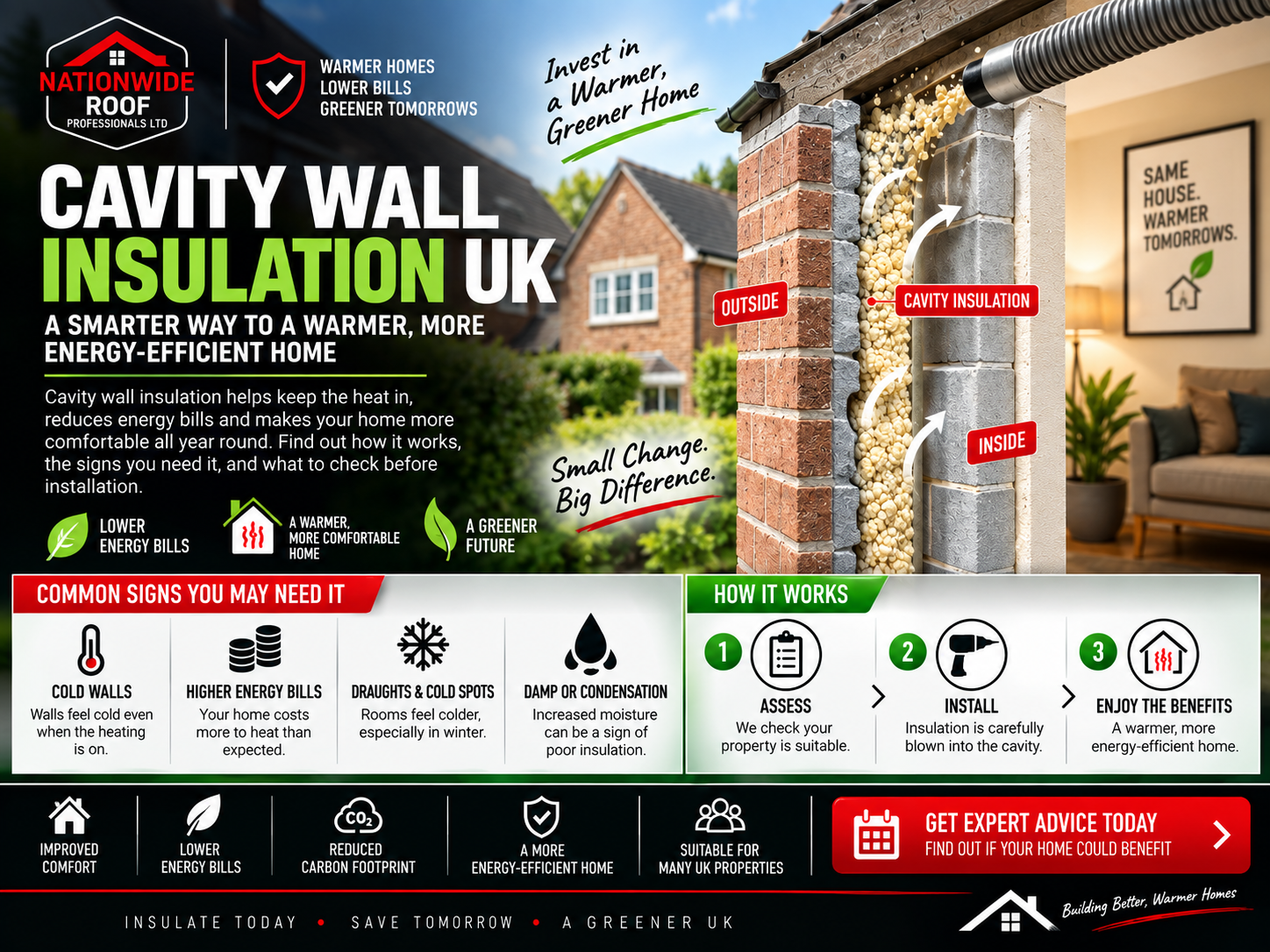
Quick answer: Cavity wall insulation fills the gap between the two layers of an external wall with material such as mineral wool, EPS beads, or foam, cutting heat loss through the walls. Signs you need it include cold internal walls and high heating bills, while damp patches or mould after existing insulation was installed can signal a failed or unsuitable installation.
Most UK homes built after the 1920s have a cavity wall, a gap between the inner and outer layer of brickwork, originally designed to stop rain penetrating through to the inside. That same gap, left unfilled, is also one of the biggest sources of heat loss in an ordinary home. Cavity wall insulation closes that gap with insulating material, and for the right property, it is one of the most effective single upgrades available for reducing heat loss through the walls.
This guide covers how cavity wall insulation works, how to know if your home is suitable, and the warning signs that existing insulation may have failed.
What Is Cavity Wall Insulation?
A cavity wall is built as two separate leaves of brickwork or blockwork with a gap between them, usually fifty to seventy five millimetres wide. The gap was originally left empty, relying on the air space itself to prevent moisture crossing from the outer wall to the inner one.
Cavity wall insulation fills that empty gap with an insulating material, most commonly mineral wool, expanded polystyrene beads, or polyurethane foam. Once installed, the material significantly reduces the rate at which heat passes from the warm inside of the home through the wall to the cold outside air, without affecting the wall’s ability to keep rain out.
How Cavity Wall Insulation Is Installed
Installation typically involves drilling a pattern of small holes, roughly twenty five millimetres in diameter, into the outer wall at set intervals. The insulating material is then blown or injected into the cavity through these holes under controlled pressure, filling the gap evenly across the entire wall.
Once the cavity is fully filled, the holes are sealed with matching mortar, and in most cases the repair is barely visible once weathered in. The process for a typical semi detached property is usually completed within a single day, with no need to move out or clear rooms, since all the work happens from the outside of the property.
Is Your Home Suitable for Cavity Wall Insulation?
Not every property is a good candidate, and installing insulation in an unsuitable wall can cause more problems than it solves. Before recommending cavity wall insulation, a proper survey should check for the following:
Wall Construction
The property needs a genuine cavity wall, not solid brick construction. Homes built before around 1920 are more likely to have solid walls, which require a different insulation approach entirely, such as internal or external wall insulation rather than cavity fill.
Cavity Width
Building regulations set a minimum cavity width for insulation to be installed safely, since a cavity that is too narrow does not allow adequate clearance between the insulating material and the outer wall, which can increase the risk of moisture bridging across to the inner leaf.
Exposure to Wind Driven Rain
Properties in particularly exposed locations, such as coastal areas or elevated sites with little shelter, face a higher risk of wind driven rain penetrating the outer wall. In highly exposed conditions, some insulation types are not recommended, and a site specific assessment should determine the safest material and approach.
Existing Wall Condition
Cracked render, damaged pointing, or existing damp issues should be addressed before insulation is installed, since filling a cavity does not fix an underlying moisture problem and can, in some cases, make it more noticeable by trapping existing damp closer to the inner wall.
A reputable installer will always survey the property first and explain clearly if cavity wall insulation is not suitable, rather than proceeding regardless.
Signs You Would Benefit From Cavity Wall Insulation
If your home has an unfilled cavity, common signs that the walls are losing significant heat include cold spots on internal walls even when the heating has been running for some time, higher than expected heating bills relative to similar sized homes, and rooms that struggle to hold heat once the heating switches off.
A simple way to check is to feel an external facing wall from the inside during cold weather. A noticeably cold wall surface, compared with an internal partition wall in the same room, often points to poor insulation in that external wall.
Signs Existing Cavity Wall Insulation May Have Failed
Cavity wall insulation is generally a long lasting measure, but problems can occur, particularly with older installations using techniques that have since been improved, or where the property was not properly assessed before installation.
Damp Patches on Internal Walls
If damp patches appear on internal walls, particularly after heavy rain, this can indicate that moisture is bridging across the cavity, either because the insulation material has settled unevenly, the property was unsuitable from the start, or the outer wall has since developed cracks that allow more water through than the insulation can safely handle.
Mould Growth in Corners or Near External Walls
Persistent mould in corners of rooms with an external wall, especially where furniture blocks airflow against that wall, can point to a combination of poor ventilation and reduced wall temperature, sometimes linked to cavity insulation that has settled or slumped within the wall, leaving gaps at the top.
A Noticeable Cold Draught Despite Insulation
If a wall known to have cavity insulation still feels cold or draughty, this can indicate partial fill, where the material has not fully covered the cavity, commonly due to obstructions within the wall during the original installation that were not properly worked around.
Blistering or Peeling External Render
In rare cases, moisture trapped within a poorly performing cavity can show up as blistering paint or render on the outside of the property, indicating that water is not draining or evaporating as it should.
If any of these signs are present, a specialist survey using a borescope camera inserted into the cavity can confirm the condition and coverage of the existing insulation without needing to remove any brickwork.
Cavity Wall Insulation and Ventilation
Filling a cavity does not affect the ventilation of the living space directly, since the cavity itself was never part of the home’s air circulation. However, homes undergoing multiple efficiency upgrades at once, cavity insulation alongside loft insulation and improved window seals, should ensure that trickle vents and extractor fans remain functional, since a more airtight property overall needs adequate mechanical ventilation to manage moisture from cooking, bathing, and daily living.
This is the same principle that applies to loft spaces after insulation upgrades, where reduced airflow without adequate ventilation increases condensation risk. Our guide to loft ventilation and condensation problems explains this in more detail for the roof space specifically.
Cavity Wall Insulation Compared With Other Wall Insulation Methods
For properties with solid walls rather than a cavity, insulation is still possible but requires a different method. Internal wall insulation involves fixing insulated plasterboard or a stud framework with insulation to the inside face of external walls, which reduces room size slightly but avoids any change to the exterior appearance.
External wall insulation involves fixing insulation boards to the outside of the property and finishing with a render system, which avoids any loss of internal space and can refresh the appearance of an older property, though it is a larger scale, more visually disruptive project than cavity fill.
For any property where a genuine cavity exists, cavity wall insulation remains the simplest, least disruptive, and generally most cost effective route to reducing heat loss through the walls, precisely because it uses a gap that already exists rather than adding new material to either face of the wall.
Types of Cavity Wall Insulation Material
Mineral Wool
Mineral wool, made from spun rock or glass fibre, is one of the most widely used cavity fill materials. It is non combustible, resistant to moisture absorption, and has a long track record in UK housing stock. It is blown into the cavity as loose fill, settling to conform to the shape of the wall.
Expanded Polystyrene Beads
EPS beads are small polystyrene granules, often coated with a bonding agent, that are blown into the cavity and bind together once in place. Bead systems are popular for retrofit projects because they flow easily around existing obstructions within the cavity, such as wall ties and cables, reducing the risk of gaps forming during installation.
Polyurethane Foam
Foam systems expand once injected into the cavity, filling the space completely as they cure. Foam offers strong thermal performance for a given thickness but requires precise installation, since over injection or poor mixing can lead to uneven fill or excessive pressure on the cavity walls.
Each material has a place depending on the property type, cavity width, and local exposure conditions, which is why the choice should follow a proper survey rather than a generic, one size fits all recommendation.
The Energy Saving Case for Cavity Wall Insulation
Heat loss through external walls typically accounts for a larger share of a home’s total heat loss than any single other element, including the roof. Filling an empty cavity directly reduces this loss, which in turn reduces how hard the heating system needs to work to maintain a comfortable indoor temperature.
The scale of the benefit depends heavily on the size and exposure of the property, the current state of the walls, and how the insulation interacts with other measures already in place, such as loft insulation and double glazing. Properties that have already addressed loft insulation but left cavity walls unfilled often see a proportionally larger improvement from cavity insulation, since it becomes the largest remaining gap in the building’s thermal envelope.
Grants and Support for Cavity Wall Insulation
Various UK government backed energy efficiency schemes have, at different times, offered support toward the cost of cavity wall insulation for eligible households, typically targeted at properties with lower energy efficiency ratings or occupants meeting certain income or benefit criteria. Eligibility criteria and scheme availability change periodically, so checking current government guidance directly is the most reliable way to confirm what support, if any, applies to your specific circumstances at the time you are considering the work. If you are combining cavity wall work with other upgrades, such as loft boarding or a ventilation improvement, it is worth discussing the full scope with your installer at the same time.
Frequently Asked Questions
How do I know if my house has cavity walls?
Cavity walls are common in properties built from the 1920s onward, though the exact date varies by region and builder. A simple check is the brick pattern. Solid walls typically show a mix of brick orientations including headers, the short end of the brick, visible on the surface, while cavity walls usually show only the long face of each brick, known as stretcher bond.
Can cavity wall insulation cause damp?
Properly installed cavity wall insulation in a suitable property should not cause damp. Problems generally arise when a property was unsuitable from the start, such as high exposure to wind driven rain, or when installation was not carried out to the correct standard. A pre-installation survey is designed to catch these risks before work begins.
How long does cavity wall insulation last?
When installed correctly in a suitable property, cavity wall insulation typically lasts for the lifetime of the building, with no need for replacement under normal conditions.
Can cavity wall insulation be removed if there is a problem?
Yes. If a survey confirms that existing insulation is causing damp or has failed, it can be extracted from the cavity, similar in principle to the spray foam removal process used in loft spaces, restoring the original air gap before considering an alternative insulation approach if appropriate.
Does cavity wall insulation affect a mortgage or property sale?
Cavity wall insulation itself does not typically cause mortgage issues, provided it was installed by a certified installer with the correct guarantee documentation. Keeping this paperwork safe and available for future buyers or lenders is worth doing at the time of installation.
What to Expect on Installation Day
Installers typically arrive with the blowing or injection equipment set up outside the property, connected by hose to the drilling points around the exterior wall. Access equipment such as a small tower or ladder is used to reach upper floor drill points safely.
Inside the home, disruption is minimal since almost all the work happens outdoors. It is worth moving anything sensitive away from external walls temporarily, such as artwork or electronics on affected walls, purely as a precaution, though properly executed installation should not cause any indoor mess or damage.
Once complete, the installer should provide a guarantee document, usually backed by an independent body such as Cavity Insulation Guarantee Agency, which protects the homeowner if a problem develops with the insulation later. Keeping this document safe is important, since it may be requested during a future property sale or mortgage application.
Cavity Wall Insulation Across London, Surrey and the South East
Housing stock varies considerably by area, which affects cavity insulation suitability. Many London terraces and semis built in the 1930s have narrower cavities that need careful material selection, while newer developments across Surrey and the South East typically have wider, more straightforward cavities to fill. Nationwide Roof Professionals surveys and installs cavity wall insulation for homeowners throughout these areas, matching the material to the specific wall type found on site.
Getting a Proper Assessment Before You Insulate
Cavity wall insulation can meaningfully reduce heat loss and lower energy bills, but only when it is right for the property in the first place. A brief external glance is not enough to confirm suitability, which is why a proper survey matters more than the installation itself.
Our team at Nationwide Roof Professionals assesses cavity wall insulation as part of our wider insulation services, alongside loft, floor, and specialist insulation options. If you are unsure whether your home is suitable, or you suspect existing insulation may have failed, request a free survey and we will give you a straightforward answer based on what we actually find in your walls.