
Roof Replacement in the UK: When You Need One and What to Expect
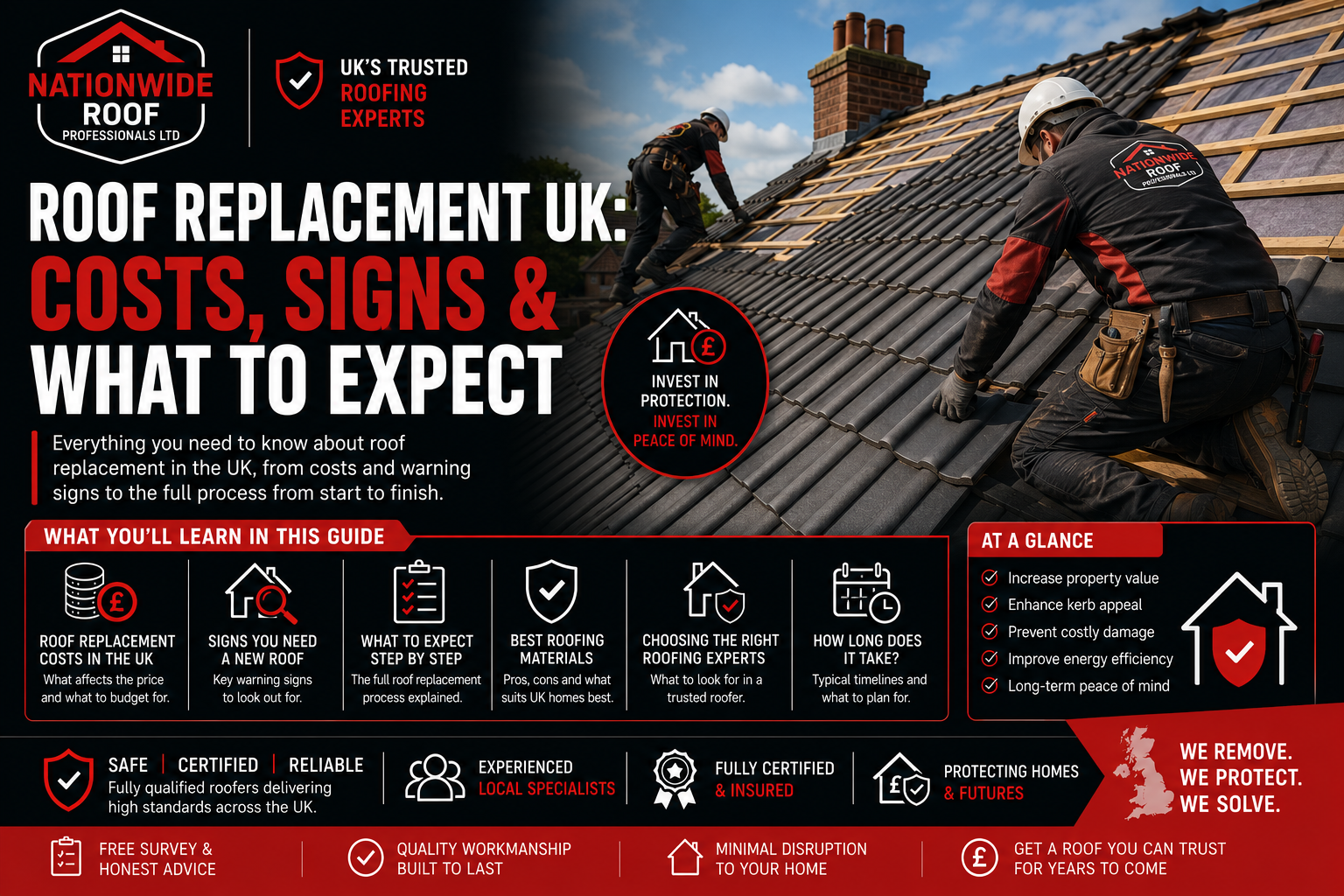
A roof replacement is one of the largest single investments a homeowner makes. Carried out correctly, a new roof gives 30 to 50 years of protection with minimal maintenance. Choose the wrong contractor or the wrong materials and you face problems within two years. This guide covers the warning signs that a full replacement is needed, realistic UK costs, tile and slate options, and the questions to ask any roofing contractor before signing a contract.
Signs That Your Roof Needs Replacing Rather Than Repairing
Age is the first variable. Concrete interlocking tiles have a typical lifespan of 30 to 50 years. Clay tiles last 50 to 80 years. Natural slate can last 80 to 100 years, though fixings, battens and underlay will need replacement well before the slates wear out. If your roof is approaching or past these thresholds, repair costs will accumulate faster than replacement.
Multiple leaks in different locations are a strong replacement signal. One leak is localised. Three or four leaks over two years suggest the underlying felt or structure is deteriorating across a broad area. At this point, patching typically costs more over five years than a single quality replacement.
A sagging or visibly uneven roofline indicates structural failure beneath the covering. Rafter decay, ridge board splitting or purlin movement all manifest as a visible departure from a clean straight roofline. This needs immediate professional assessment. Our roofing team carries out full structural inspections as part of every re-roof project.
What a Full Roof Replacement Involves
A complete roof replacement begins with stripping all existing tiles or slates down to the bare roof structure. This is the point at which the actual structural condition is revealed, which is why contractors who quote a fixed price without first stripping the existing covering are making assumptions they cannot support.
Every rafter, purlin and ridge board is inspected for signs of moisture, rot or insect damage. Compromised timbers are sistered or replaced before the new covering goes on. New breathable underlay is laid across the full roof area. New treated battens are fixed over the underlay and tiles or slates are laid from the eaves to the ridge.
Ridge tiles are fitted with a dry fix mechanical ridge system as standard on any quality re-roof project. Dry fix ridges do not crack or fail as mortar ridges do, and they do not require re-pointing. Flashings, valley gutters and any associated leadwork are all replaced as part of the project. Our full re-roof service includes a written scope of works before any commitment is made.
Roof Replacement Costs in the UK
| Property Type | Concrete Tile | Clay Tile | Natural Slate |
| 2 bed terrace | 4,500 to 7,000 GBP | 6,500 to 9,500 GBP | 8,000 to 13,000 GBP |
| 3 bed semi detached | 6,000 to 10,000 GBP | 9,000 to 14,000 GBP | 11,000 to 18,000 GBP |
| 4 bed detached | 9,000 to 16,000 GBP | 13,000 to 20,000 GBP | 16,000 to 28,000 GBP |
| Scaffolding (add to above) | 700 to 2,000 GBP | 700 to 2,000 GBP | 700 to 2,000 GBP |
Structural repairs identified during stripping are typically quoted separately because their extent cannot be known until the covering is removed. Always ask contractors how additional work is authorised and documented before signing any contract.
Choosing the Right Roofing Material
Concrete interlocking tiles offer the best cost to durability ratio for most UK properties. They are available in a wide range of profiles, colours and finishes, have a lifespan of 30 to 50 years, and replacement tiles are straightforward to source.
Natural clay tiles carry a longer lifespan and offer a warmth of appearance that concrete cannot replicate. For period properties across London and Surrey, clay is often the appropriate choice both aesthetically and for planning purposes.
Natural Welsh or Spanish slate delivers exceptional longevity, typically 60 to 80 years for quality material. It suits period properties where the original covering was slate and where conservation area requirements specify like for like replacement. Fibre cement slate closely replicates the appearance at significantly lower cost.
Roofing and Loft Insulation: The Right Time to Combine
A full roof replacement is the most practical time to also upgrade loft insulation. The roof space is fully accessible, the structure is visible, and insulation can be installed to exactly the correct specification without a second period of disruption.
We regularly combine loft insulation upgrades with re-roof projects. If spray foam is present, our spray foam removal service can be sequenced to complete before the new covering is installed, giving a complete roof system upgrade in a single project.
Roof Replacement in London and Surrey
Properties across London, Surrey and the wider South East present specific roofing challenges. Victorian and Edwardian terraces in Croydon, Sutton, Wimbledon, Clapham, Guildford, Kingston and Woking often have complex rooflines with hips, valleys, dormers and party wall abutments. These details require experienced roofers who understand how period properties are constructed.
Conservation area requirements in many London boroughs and Surrey districts specify particular tile types or finishes. Our team works within these constraints as a matter of course, advising on appropriate materials before any specification is finalised.
How to Avoid a Poor Roofing Contractor
Scaffold must be included or clearly itemised. Any contractor offering to carry out a full re-roof without scaffolding should be declined immediately. Working at height regulations make it mandatory for work of this nature.
Get a written specification before signing anything. Materials, tile type and specification, underlay, ridge system, flashings, waste disposal and guarantee terms should all be in writing.
Check for public liability insurance and ask to see the certificate. Request to see comparable completed work or speak to previous customers. Our completed projects page shows examples of our work across London and Surrey.
Frequently Asked Questions about Roof Replacement
Does a new roof add value to a property?
Yes. A new roof removes one of the most significant buyer concerns in a transaction, supports mortgage approval and in most cases adds more value than it costs, particularly when replacing a roof that is clearly approaching end of life.
How long does a roof replacement take?
Four to seven working days for a standard residential property. Complex rooflines or properties requiring structural repairs take longer.
Does a roof replacement require planning permission?
Like for like replacement does not require planning permission in most cases. Changing the material or the roofline profile, or working on a listed building, may require consent. Always confirm with your local authority. Contact Nationwide Roof Professionals for a free assessment and written quote.